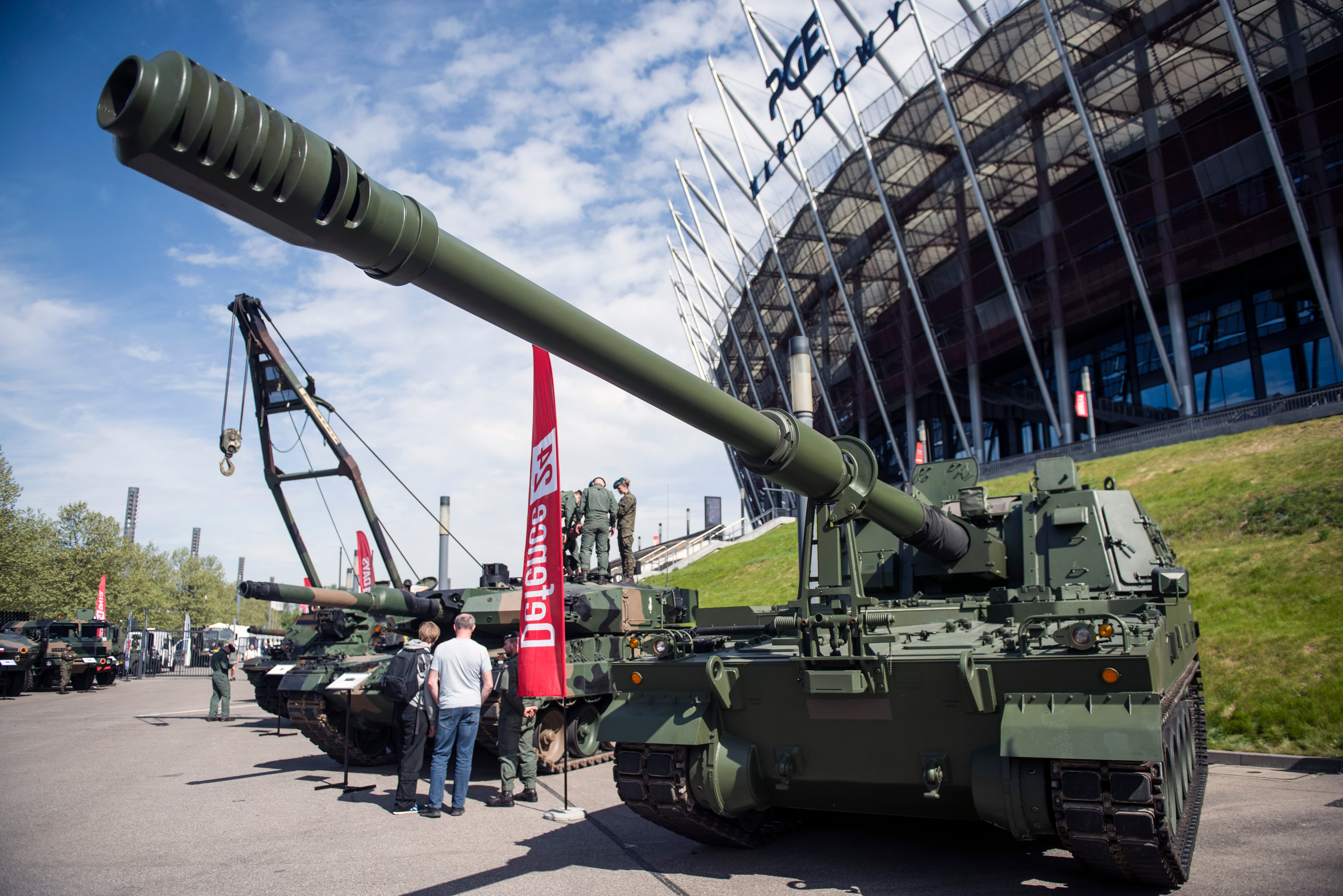
WARSAW, Poland — The Polish Ministry of National Defence has awarded contracts worth around 60 billion zloty ($16.5 billion) to buy infantry fighting vehicles, self-propelled howitzers, military vehicles, and self-propelled wheeled mortars, among other weapons, to a group of local defense companies.
The purchases will be bankrolled by the European Union’s Security Action for Europe (SAFE) low-cost loan program.
At the official signing ceremony held May 30, Władysław Kosiniak-Kamysz, Polish deputy prime minister and defense minister, criticized Poland’s right-wing President Karol Nawrocki for vetoing a bill that was to enable the government to utilize the Brussels loan scheme.
Nawrocki has claimed that “SAFE is a mechanism through which Brussels can withhold funding at will.” Due to his opposition to the scheme, Poland’s centrist Cabinet was forced to implement the loans through executive action.
“They say the terms are not favorable. These are twice as favorable as the first contracts signed in [South] Korea,” Kosiniak-Kamysz said, referring to the weapon acquisitions from the South Korean industry contracted by Poland’s previous government. “I was in the opposition at that time, and I wasn’t complaining about those … [acquisitions] because it was a time when it was necessary to look for markets where it was possible to buy fast.”
The ministry’s May 30 purchases include 146 Borsuk tracked infantry fighting vehicles, 96 Krab 155mm self-propelled howitzers, 1,000 ammunition, command, and communications vehicles for the Homar-K multiple rocket launcher system, and 64 Rak 120mm self-propelled wheeled mortars.
The contracts were awarded to a group of companies led by state-run defense giant PGZ, and signed at the headquarters of Huta Stalowa Wola (HSW), a PGZ subsidiary focused on the development of howitzers, infantry fighting vehicles and other gear for the land forces.
Kosiniak-Kamysz said that, in addition to procuring the necessary equipment for the Polish military, the contracts are to enable Poland’s defense industry to boost its production capacities for export sales.
“Now we have to build up the strength and potential not only for producing for our own needs, but also for exports of what is today our strategic asset,” the deputy prime minister said.
In total, Poland has been allocated some €43.7 billion ($50.9 billion) in loans by Brussels for defense acquisitions carried out under the SAFE scheme. This potentially makes the nation the largest beneficiary of the program.
Mariusz Błaszczak, Poland’s former Minister of National Defence who is a lawmaker for the opposition Law and Justice party, told Defense News that using SAFE loans to purchase weapons creates the risk of the EU’s interference in what type of equipment Warsaw will buy for the military. He also voiced concern that, by sourcing funds through the scheme, Poland could reduce its purchases from the United States and begin favoring European suppliers.
“For Law and Justice, security is not a field for political experiments. It is a matter of strategic responsibility and the consistent strengthening of the alliance with the USA and Poland’s position in NATO,” Błaszczak said.
At the same time, Kosiniak-Kamysz said that, alongside purchases from its defense industry, Poland will continue to source weapons from allied countries, including the United States.
“This doesn’t change the fact that, while there is SAFE, other deals do not disappear. We have deals with the United States for more than 200 billion zloty,” the politician said.
Also on May 30, the ministry awarded a contract worth more than 13.5 billion zloty to procure “several hundred thousand” 155mm artillery rounds from a PGZ-led consortium. Drawing lessons from the war in neighboring Ukraine, the Polish authorities have intensified efforts to build up the country’s ammunition stockpiles, but also secure domestic manufacturing capacities.
“Every single one of the hundreds of thousands of ordered shells will be produced in Poland, ensuring complete independence in the possession of this key artillery caliber. Every shell body delivered under this contract will be forged in Poland and filled at Polish facilities using Polish TNT,” Arkadiusz Bąk, PGZ’s first vice president, was quoted in a statement released by the group.
In September 2025, PGZ selected the U.K.’s BAE Systems as its technology partner for the ongoing ramp-up of local artillery ammunition production.
Jaroslaw Adamowski is the Poland correspondent for Defense News.