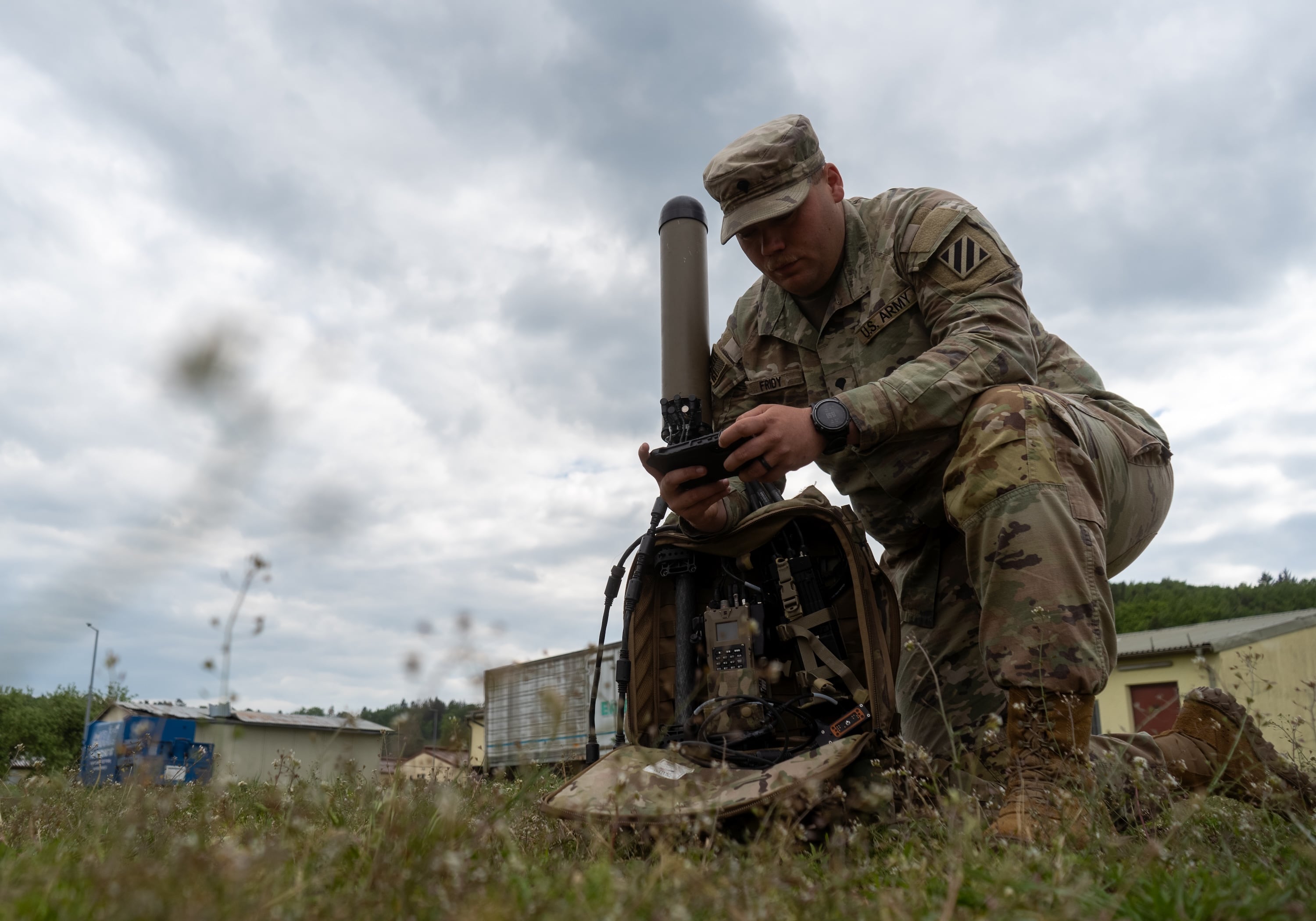
As the U.S. Army embarks on a massive reorganization of its acquisition agencies, it’s also changing the ways it acquires electronic warfare and signals intelligence systems.
The problem is that “the Army lacks the ability to sense, locate, attack, and protect” across the electromagnetic spectrum, warned Gen. David Hodne, commander of Transformation and Training Command.
This is partly the result of an acquisition system for electromagnetic spectrum operations, or EMSO, that is too fragmented.
“Currently, EMSO capabilities are spread across different warfighting functions and not fully designed as cohesive technologies that are modular, scalable, and adaptable enough to mitigate modern threats,” Hodne wrote in a January memo on the new EMSO concept of operations.
“This prevents the Army from truly leveraging Artificial Intelligence and Machine Learning (AI/ML) for quick decision making to exploit opportunities across the competition continuum.”
Thus, the Army is seeking feedback from industry on both the Army’s new concept of EMSO and a potential Indefinite Delivery/Indefinite Quantity contract for procurement of EW and SIGINT equipment.
The Program Manager Electronic Warfare & Cyber “is exploring an acquisition strategy to provide commercially sourced, worldwide, end-to-end lifecycle management products for the Army’s portfolio of Electromagnetic Warfare (EW) and Signals Intelligence (SIGINT) systems,” according to the Army’s Request for Information. Responses are due by March 13.
Among the questions is whether industry is willing to invest money in order to deliver solutions more quickly.
“If the Government were to leverage multi-year procurement contracts, would vendors pay facilitation costs to increase production quantities or significantly improve production schedules for EW/SIGINT Equipment?” the RFI asked.
The Army also wants systems that are tailored for different types of users.
“Fielding a common basis of issue (BOI) across varied formations (e.g., heavy, light, airborne) has proven to be neither cost-effective nor optimal for ensuring battlefield lethality against modern, technologically advanced adversaries,” the RFI noted.
The Army is soliciting feedback on the EMSO concept of operations itself, including the desire for “industry partnerships” cited in the January memo.
“What partnership models would be most effective for the rapid development and fielding of EMSO capabilities?” the RFI asked.
Hodne’s memo envisions speeding up the fielding of new systems by having T2COM program managers work closely with Command and Control/Counter C2 Portfolio Acquisition Executive.
“This approach enables continuous integration and delivery of EMSO capabilities for operations in austere and DDIL [denied, disrupted, intermittent and limited-bandwidth] environments,” the memo said.
The memo also called for a variety of offensive and defensive electromagnetic capabilities, including protocol-based effects that target specific communications protocols, simultaneously identifying and locating multiple enemy emitters, and obscuring friendly electromagnetic signatures from enemy detection. EMSO systems should also have an open architecture that can be integrated with the Next-Generation Command-and-Control framework.
Michael Peck is a correspondent for Defense News and a columnist for the Center for European Policy Analysis. He holds an M.A. in political science from Rutgers University. Find him on X at @Mipeck1. His email is mikedefense1@gmail.com.