COLOGNE, Germany — The German government plans to equip its military forces with one-way attack drones, setting up three domestic manufacturers for deals that could reach billions of euros.
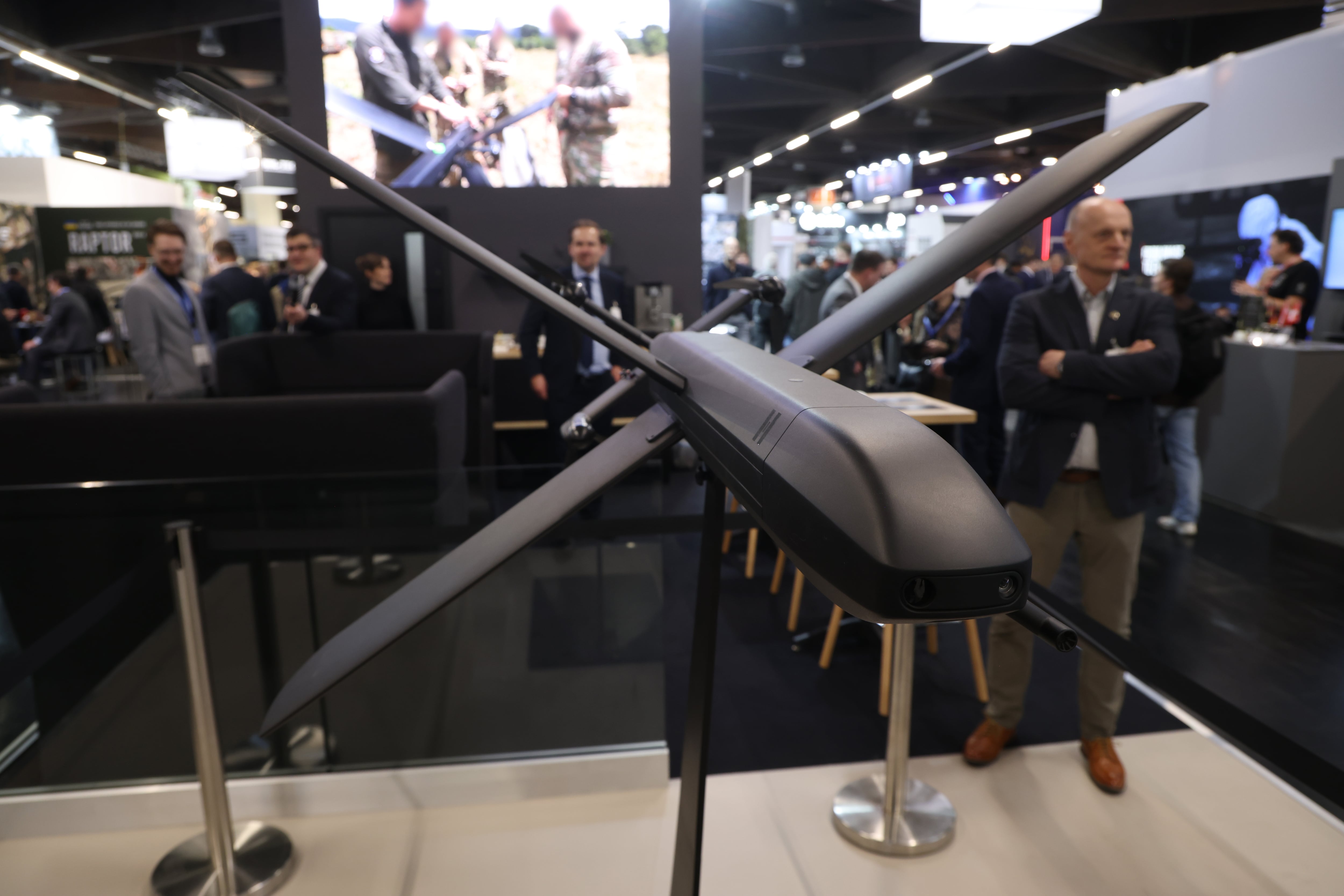
Lawmakers on the parliamentary budget committee on Feb. 25 approved contracts worth €268 million ($316 million) each for startups Stark Defence and Helsing to supply the Virtus and HX-2 loitering munitions, respectively. Contractual options could add €1 billion to each of the deals, provided the systems prove technologically mature and lawmakers agree to additional purchases.
A third offer by defense giant Rheinmetall is expected for budget committee consideration within weeks and will receive the same spending plan, according to Andreas Schwarz, budget committee member and point man for the Social Democratic Party (SPD) in defense budget matters.
“We want to treat everybody equally,” Schwarz told Defense News.
Rheinmetall announced last week the successful demonstration of its FV-014 loitering munition to a “potential NATO customer” at a range in Germany.
Having three manufacturers on tap means defense leaders and lawmakers are in a position to guide the future flow of money to the most capable offerings, Schwarz said.
Loitering munitions are designed to fly to a general target area, stay airborne above it and automatically propose strike targets to human operators a safe distance away. The target selection process happens by way of on-board sensor data collection and analysis, supported by artificial intelligence.
When cleared for attack, the drones lock on to a target and try to ram their warhead into it.
The deadly technology is so effective in the war in Ukraine that large stretches of the front line are no-go areas for human soldiers.
The German parliament agreeing to spend large sums on these types of weapon is part of a remarkable turnaround for the European country’s military posture since Russia’s full-scale invasion of Ukraine four years ago. Previously, lawmakers, including in the SPD, were wary of allowing the military to install weapons of any kind on drones.
“We have to adapt to the realities that exist in the world,” Schwarz told Defense News.
As a first step, the three German manufacturers’ weapons are destined to equip Germany’s armored brigade in Lithuania in 2027.
Speed in fielding the new weapons is of the essence for German military leaders. Having soldier testing and training happening in parallel rather than sequentially is meant to save time, according to a defense ministry statement.
Such an approach typically increases risk in defense acquisitions, especially when fielding novel technology.
That’s why lawmakers attached reporting requirements to the approved spending plan, designed to keep a close watch on the progress. Cancellation clauses also enable the government to walk away from offerings if manufacturers fail qualification tests.
Meanwhile, manufacturer Stark Defence has managed to assuage lawmakers’ concerns about the involvement of libertarian U.S. investor Peter Thiel in the company.
Thiel’s shares in Stark amount to a one-digit percentage, which means he has no access or insight into the startup’s operative business, Defense Minister Boris Pistorius told reporters on Wednesday.
Pistorius and Schwarz said they were content with have a written commitment to that effect from the company.
Ahead of the budget committee vote, critics said Thiel’s touch could make the Stark deal iffy.
“The fact is that Peter Thiel openly rejects our democracy. We do not know how large his influence at Stark is. And even worse: The federal government cannot explain it,” Greens lawmaker Jeanne Dillschneider was quoted as saying in a Politico report on Tuesday.
Sebastian Sprenger is associate editor for Europe at Defense News, reporting on the state of the defense market in the region, and on U.S.-Europe cooperation and multi-national investments in defense and global security. Previously he served as managing editor for Defense News. He is based in Cologne, Germany.