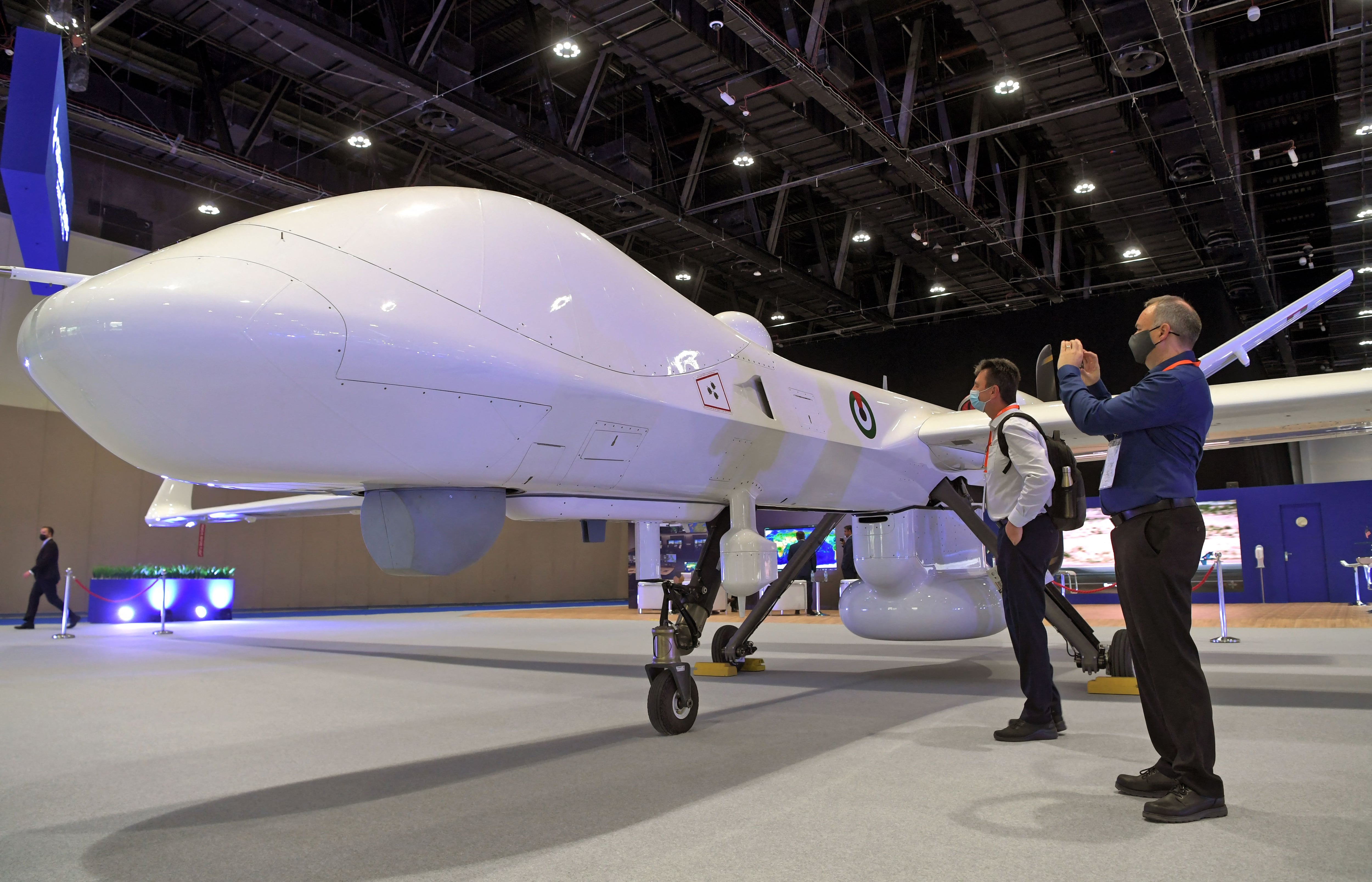
MILAN — Armed with a fresh defense-cooperation agreement, Denmark and Canada stand to exploit their shared use of MQ-9B drones as a practical touchpoint for Arctic surveillance, according to issue experts.
The Danish Air Force officially established Squadron 729 on Feb. 16, which will operate the four MQ-9B long-range unmanned aircraft out of Aalborg Air Base, located in northern Denmark, starting from 2028.
Earlier this month, Canada, which has acquired 11 of the same General Atomics-made drones that it will receive around the same time, signed a defense cooperation agreement with Denmark at the Munich Security Conference. The systems are planned to be based in different locations, including Nova Scotia on the east coast and British Columbia on the Canadian west coast.
The team-up brings together two Arctic nations that have repeatedly drawn the ire of Donald Trump since he assumed his second term as U.S. president in early 2025. Trump harbors a grudge against Canada for not wanting to be part of the United States, and against Denmark for having no interest in giving him the Danish autonomous territory of Greenland.
The defense-technical nexus around the MQ-9B drone holds promise in forging a closer connection between Ottawa and Copenhagen, as there is currently no formal maintenance-sharing or data-sharing arrangement between the two nations, according to issue experts.
“A joint logistics or maintenance hub would absolutely be strategically beneficial for them – maintaining equipment and operating bases in the region is very expensive – sharing facilities and having an integrated logistics system can make operations easier and more efficient for all parties involved,” Jens Marquard Sørensen, director of a Danish consulting company, said.
Still, both countries must first evaluate whether their operational plans match up.
For example, basing the Danish fleet at Aalborg Air Base would colocate the equipment with air force maintenance expertise there, but it’s a long way from strategic patrol points in Greenland, said Sørensen.
“The long distances [from Aalborg] to Greenland may pose operational challenges – flight times are long, increasing wear on drones before they arrive for a mission, and they would lose fuel going there. … It also means that any kind of rapid reaction using the MQ-9Bs is not possible, so having a forward operating station in the Arctic itself would be a notable advantage,” he said.
To put this into perspective, the straight-line distance between the Danish air base and Nuuk is approximately 3,324 kilometres (2,065 miles), and commercial jets covering the same route average flight times of about four to five hours.
Rune Raunow, a defense consultant at the Copenhagen-based Rethink Advisory, which advises the Danish Armed Forces, said a Denmark-Canada pact around the U.S.-made surveillance drones would be especially relevant for contingency plans, refueling or emergency landings.
Cooperation on sensors, too, could factor into the equation, Raunow said. While the Canadian government has opted for L3 Harris Wescam MX-20D sensor systems for intelligence and surveillance missions, Denmark has not publicly disclosed its preference.
“The drones are essentially just a platform; what will be more relevant is whether they will buy the same set of communication networks, sensors, optic detection systems, etc. … Being able to track threats in these very remote places would be extremely easier if they were using the same equipment,” Raunow said.
Canada’s MQ-9B purchase was driven by its need to bolster Arctic operations and provide continuous intelligence, surveillance, and reconnaissance, according to government statements.
While stationing its fleet in southern bases is consistent with existing airfields and maintenance infrastructure, these areas are still far from the high Arctic and other regional chokepoints, where the country has increased monitoring needs.
Sørensen suggests that if NATO was to re-open the Keflavík Air Base in Iceland, as a common allied base, even just for emergencies, it could also serve as a possible site for the countries’ MQ-9B fleets. He noted that this location is the easiest point for patrolling north, east, and south of Greenland.
Keflavík Air Base was closed in 2006 and was primarily operated by the U.S. Navy on behalf of NATO. Today, allies conduct routine and rotational fighter and bomber deployments from there, focused on air policing missions.
As a member of NATO, Iceland has no armed forces of its own.
Sørensen added that its position south of the Arctic Circle makes operations easier and less prone to weather-related disruptions, offering a closer alternative than flying from Nuuk or Canada.
“Shipping routes are also always open year-round, making it cheaper to maintain a station or base than anywhere else in the region – technicians, spare parts or even larger equipment can be transported relatively cheaply via regular civilian shipping routes versus shipping to Greenland, which can cost up to 20$ per kilogram in some areas,” Sørensen said.
Other locations to consider may include Northern Canada, which Hans Peter Michaelsen, a defense analyst and former member of the Royal Danish Air Force, highlights as geographically close to the Danish Arctic territory. However, he notes that many of these areas face significant infrastructure limitations that would obstruct the construction of year-round drone facilities.
Elisabeth Gosselin-Malo is a Europe correspondent for Defense News. She covers a wide range of topics related to military procurement and international security, and specializes in reporting on the aviation sector. She is based in Milan, Italy.