ISTANBUL — Turkey’s interception of an unidentified drone approaching from the Black Sea on Dec. 15 has highlighted growing airspace security challenges when it comes to dealing with small, low-observable aerial platforms, Turkish defense officials said.
While the Turkish armed forces have had to neutralize unmanned surface vessels and drifting sea mines since the start of the Russian invasion of Ukraine, the incident this week marked the first time an aerial threat was destroyed.
The drone intercept comes against the backdrop of the ongoing war between Ukraine and Russia, which has increased air and maritime security risks in the Black Sea region.
The Turkish defense ministry said both sides have been warned to exercise greater caution to prevent incidents that could undermine regional security.
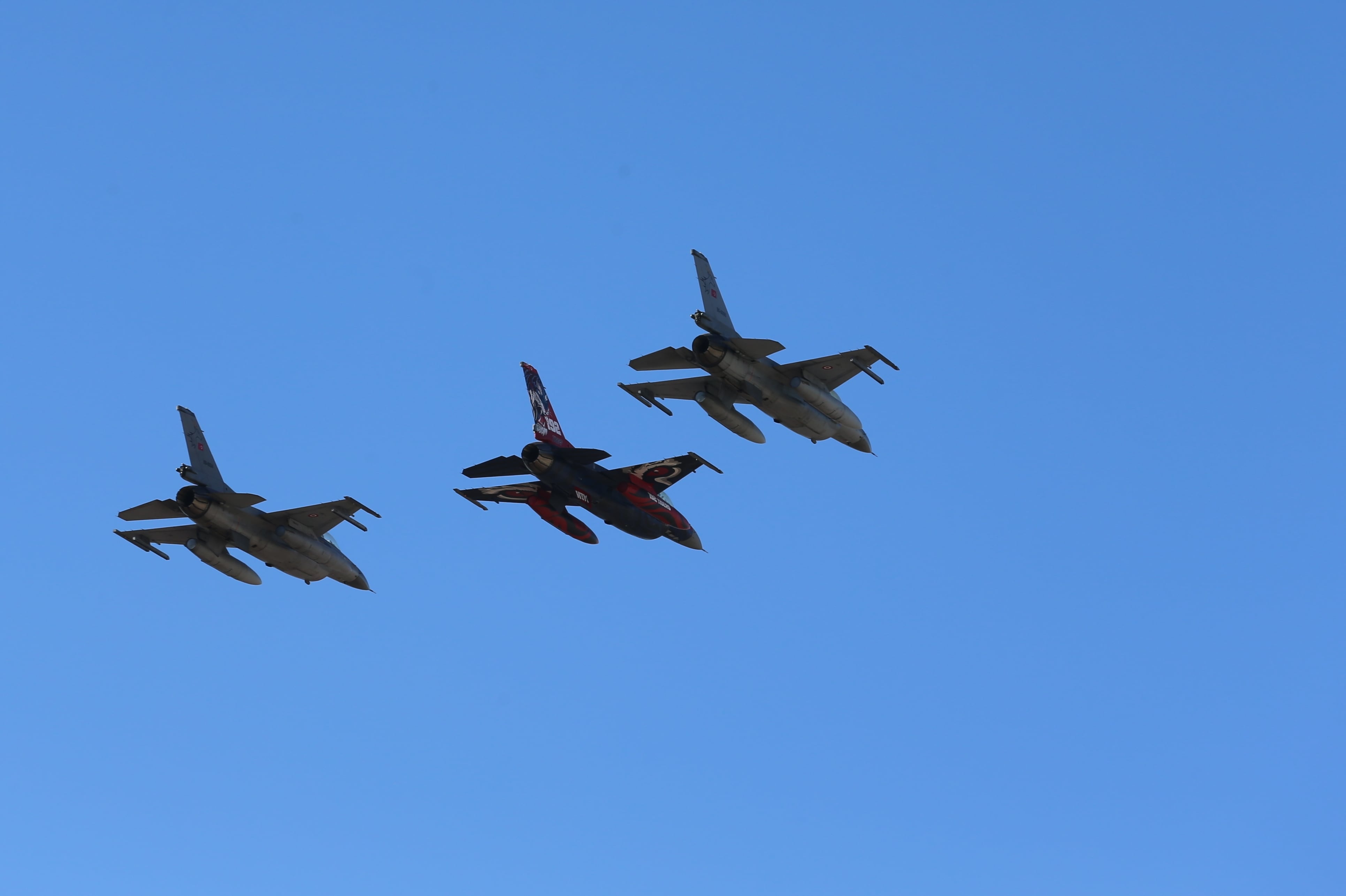
Military officials managed to spot the drone as it flew toward Turkish airspace, prompting a scramble of the F-16 fighter jets for detection, identification and tracking procedures in line with standing rules of engagement during airspace violations, the Ministry of Defense said in a Dec. 18 statement.
The craft presented a challenging target due to its small size, low radar cross-section and difficulty in accurately determining its altitude and speed, the statement reads.
As a result, Turkish forces did not rely on a single sensor, instead fusing data from radar, electro-optical systems, electronic warfare assets and early warning platforms to confirm the track, the ministry said.
While the authorities here have not disclosed details regarding the exact location or means of the shoot-down, local defense outlet SavunmaSanayiST claimed that an AIM-9X Sidewinder short-range air-to-air missile may have been used.
Separately, residents in Elmadağ, around 30 kilometers east of Ankara, shared videos on social media on the evening of Dec. 15 claiming to have heard an explosion in the air.
That location lies several hundred kilometers from the Black Sea coastline, depending on the drone’s approach.
The ministry said airspace management decisions during the incident were taken with particular sensitivity to ongoing civilian aviation activity, emphasizing that the chosen method represented the most cautious approach available under the circumstances.
The drone is believed to have fragmented into very small pieces after being shot down, dispersing debris across a wide area and complicating recovery efforts. Search, scanning and technical examination activities are continuing, with the ministry cautioning against speculative claims or disinformation until verification processes are completed.
Turkey rejected assertions that the incident exposed weaknesses in its air defense posture.
Cem Devrim Yaylali is a Turkey correspondent for Defense News. He is a keen photographer of military ships and has a passion for writing about naval and defense issues. He was born in Paris, France, and resides in Istanbul, Turkey. He is married with one son.