After a half-century of flying turboprop ISR aircraft, the U.S. Army is turning to business jets.
The service plans to buy up to 11 customized Bombardier Global 6500 aircraft for its High Accuracy Detection and Exploitation System, or HADES, program, according to the Army’s recent Request for Information. Contractors must be able to provide up to four planes per year, based on a contract award in October 2026.
The RFI specifies an aircraft that can operate at an altitude of 41,000 to 51,000 feet — identical to the cruise and maximum altitudes listed by Bombardier for the Global 6500. The aircraft should be able to carry a minimum payload of 14,000 pounds while achieving endurance of at least 12 hours.
“The mission profile is to climb to the prescribed altitude within the defined operating range ... and then loiter in a mission racetrack pattern,” the RFI said.
The plane should be capable of 450 knots sustained speed at 51,000 feet, and have the “ability to self-deploy with a range of 6,000 nautical miles,” the request adds.
The aircraft fuselage and structural components should not include composite materials except for limited areas such the nose and tail cones, as well as the pylons.
Contractors will be expected to obtain FAA certification for modifications such as integrating “wing hard points, belly canoe, SATCOM cheek radome, and any Aerial-Intelligence, Surveillance and Reconnaissance (A-ISR) capabilities,” the Army said.
Given that HADES aircraft will be packed with power-hungry ISR systems, the Army is emphasizing adequate aircraft power supply.
“Provide platform’s (excess) size, weight, power and cooling that can be applied to mission equipment,” the RFI asked. “Describe platform’s mission power distribution system.”
Contractors should also state whether their aircraft has a flight simulator, and provide estimated cost per flying hour. The RFI deadline is Feb. 12.
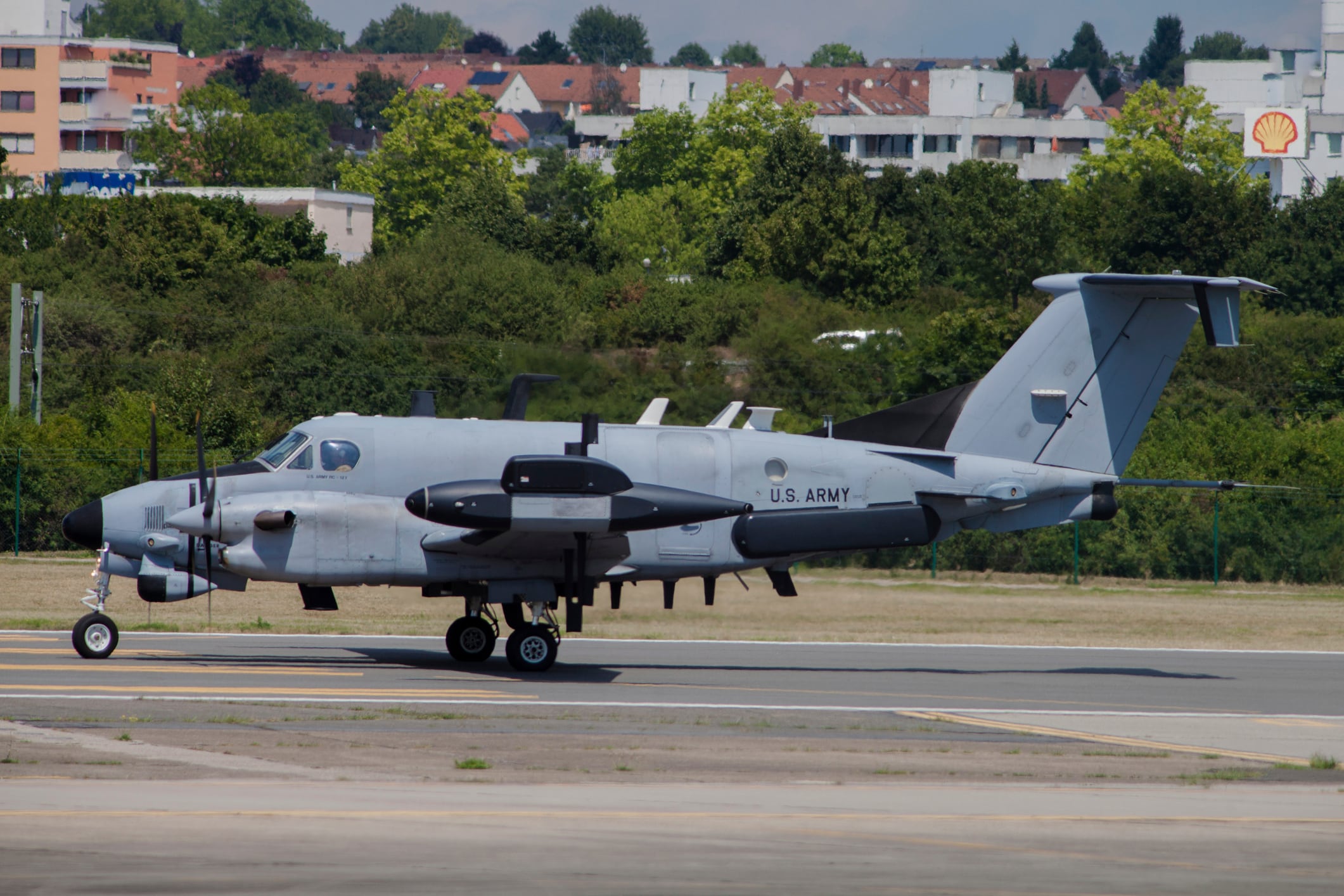
HADES comes as the Army is retiring its fleet of around 60 turboprop ISR aircraft. These include the RC-12X Guardrail and the MC-12 Enhanced Medium Altitude Reconnaissance and Surveillance System-Multiple Intelligence, or EMARSS, which are both based on the Beechcraft King Air.
Also being retired is the EO-5C Airborne Reconnaissance Low-Multifunction, or ARL-M, which is based on the de Haviland Dash 7.
These aircraft have a proud history, especially the RC-12 Guardrail, which was first deployed in 1971 with the 1st Military Intelligence Battalion in then-West Germany to monitor Soviet troop movements. The ARL-M arrived in 1996, followed by EMARSS in 2016.
But air defenses have made the skies more deadly, even for high-performance fighters, as the Army has switched from small-war counterinsurgency wars to large-scale operations. Additionally, long-range missiles and drones depend on intelligence and targeting data from long-range sensors.
“The legacy turboprop fleet has limited speed, range, altitude, power and payload carrying capacity for deep sensing,” explained an Army news release last month. “The legacy fleet could not meet requirements for near-peer competition.”
Instead, the Army is opting for a smaller ISR fleet of more capable jets.
“A smaller fleet of aircraft that can cover much larger footprints for longer periods of time is now the way forward,” said Julie Isaac, the Army’s Project Manager Sensors Aerial Intelligence.
One question is what the Army will use in between retiring its ISR turboprops and the fielding of HADES.
As a prelude to HADES, the Army tested contractor-owned-and-operated Bombardier Challenger 650 business jets through the Aerial Reconnaissance and Targeting Exploitation Multi-Mission Intelligence System, or ARTEMIS, and Airborne Reconnaissance and Electronic Warfare Systems, or ARES programs.
To bridge the gap until HADES arrives, the Army will use Global 6500s through the Army Theater-Level High Altitude Expeditionary Next-AISR, or ATHENA.