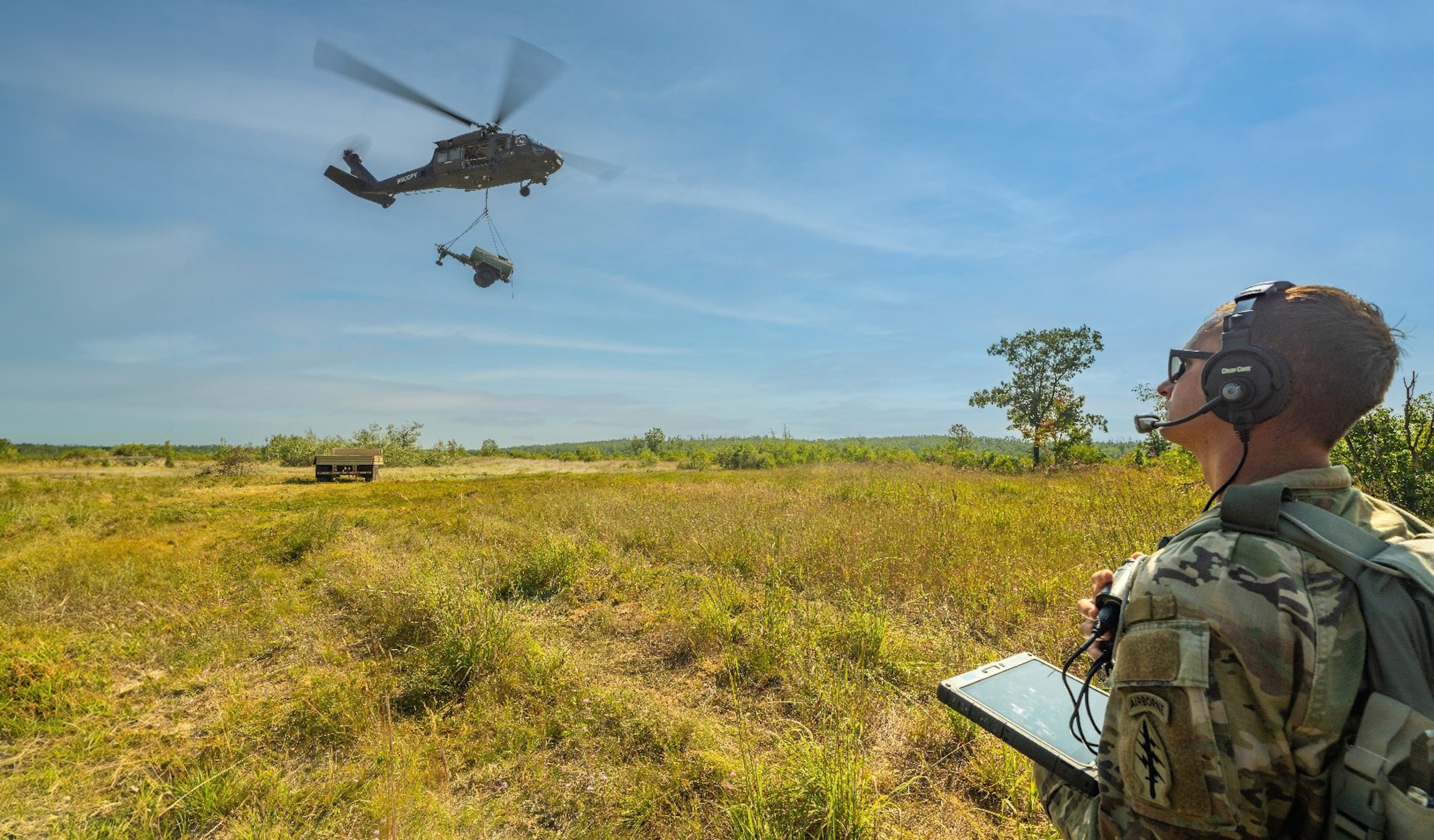
The U.S. Army wants mobile short-range air defense for light infantry forces that lack the ability to transport heavy equipment.
So, the service is looking for sled- or pallet-mounted weapons that can be hauled by light manned and unmanned vehicles during joint forced entry, or JFE, operations such as airborne assaults, according to an Army Request for Information.
The goal is to provide “air defense capability to support dismounted maneuver, JFE (C-130 transportable, air droppable, and sling load capable) and light mounted maneuver operations that are C-130 transportable and more robust than JFE solutions,” according to the RFI, which has a deadline of April 6.
The RFI for the project, called Maneuver-Short Range Air Defense Increment 4, is broadly similar to one published in 2024. However, the earlier RFI only asked for some kind of system that could be mounted on platforms such as the Joint Light Tactical Vehicle.
The 2026 RFI specifies the solution the Army has settled on: a Self-Loading Equipment Dock or pallet fitted with multiple kinetic and nonkinetic defenses. The SLED or pallet will be mounted on a variety of vehicles, including the Infantry Squad Vehicle and the unmanned Robotic Combat Vehicle.
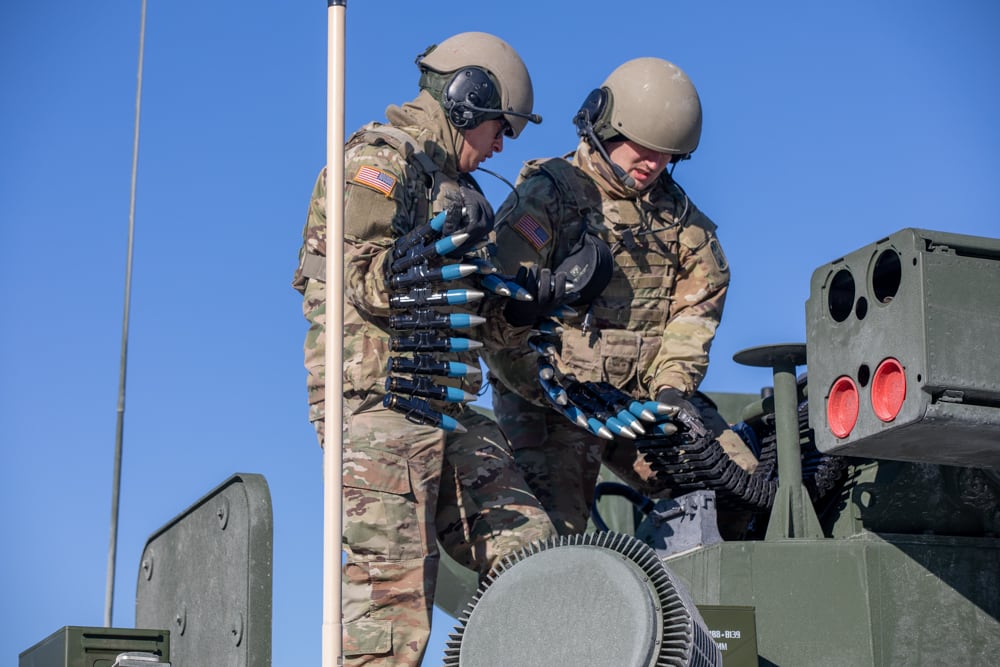
M-SHORAD Increment 4 is the lightweight part of a multitrack Army effort to develop short-range air defense systems mobile enough to accompany maneuver forces, and protect them against drones and aircraft. Increment 1 mounts missiles and a cannon on a Stryker armored vehicle, the now-canceled Increment 2 featured a laser-armed Stryker and Increment 3 will upgrade Increment 1 to include the Next Generation Short Range Interceptor missile and the XM1223 30mm cannon.
Increment 4 will target Groups 1 to 3 drones (small to medium UAVs), as well as fixed-wing aircraft and helicopters providing close air support to enemy troops. Potential kinetic weapons include the Stinger/Next Generation Short Range Interceptor; Advanced Precision Kill Weapon System; XM914 30mm cannon; and .50-caliber and 7.62mm machine guns. These will be joined by electronic warfare gear and active and passive sensors.
The Army envisions an air defense system that can either be operated while mounted on a vehicle, or dismounted. However, the system shouldn’t require full integration into the transport vehicle.
“The SLED may be carried by the vehicle, but it must maintain independent functionality,” the RFI noted. “Vehicles must be returned to complete functionality after removal of the SLED.”
The service acknowledges that this is a lot of payload to mount on a small, light platform. The Army “understands the constrained Size, Weight, and Power (SWaP) on these vehicles and intends to explore systems with this RFI which are compatible with multiple/various vehicles,” the RFI said. “Solutions should incorporate modular design for subsystems and leverage Modular Open System Approach (MOSA) in hardware and software to maximize use of highly constrained SWaP resources.”
The Army is aiming for a system that can fielded in the 2027 to 2029 timeframe. To hasten development, the Army will “leverage existing programs of record and other high-TRL [Technology Readiness Level] components for the initial capability with intent to compete future capabilities in this reconfigurable system,” the RFI said.
Michael Peck is a correspondent for Defense News and a columnist for the Center for European Policy Analysis. He holds an M.A. in political science from Rutgers University. Find him on X at @Mipeck1. His email is mikedefense1@gmail.com.