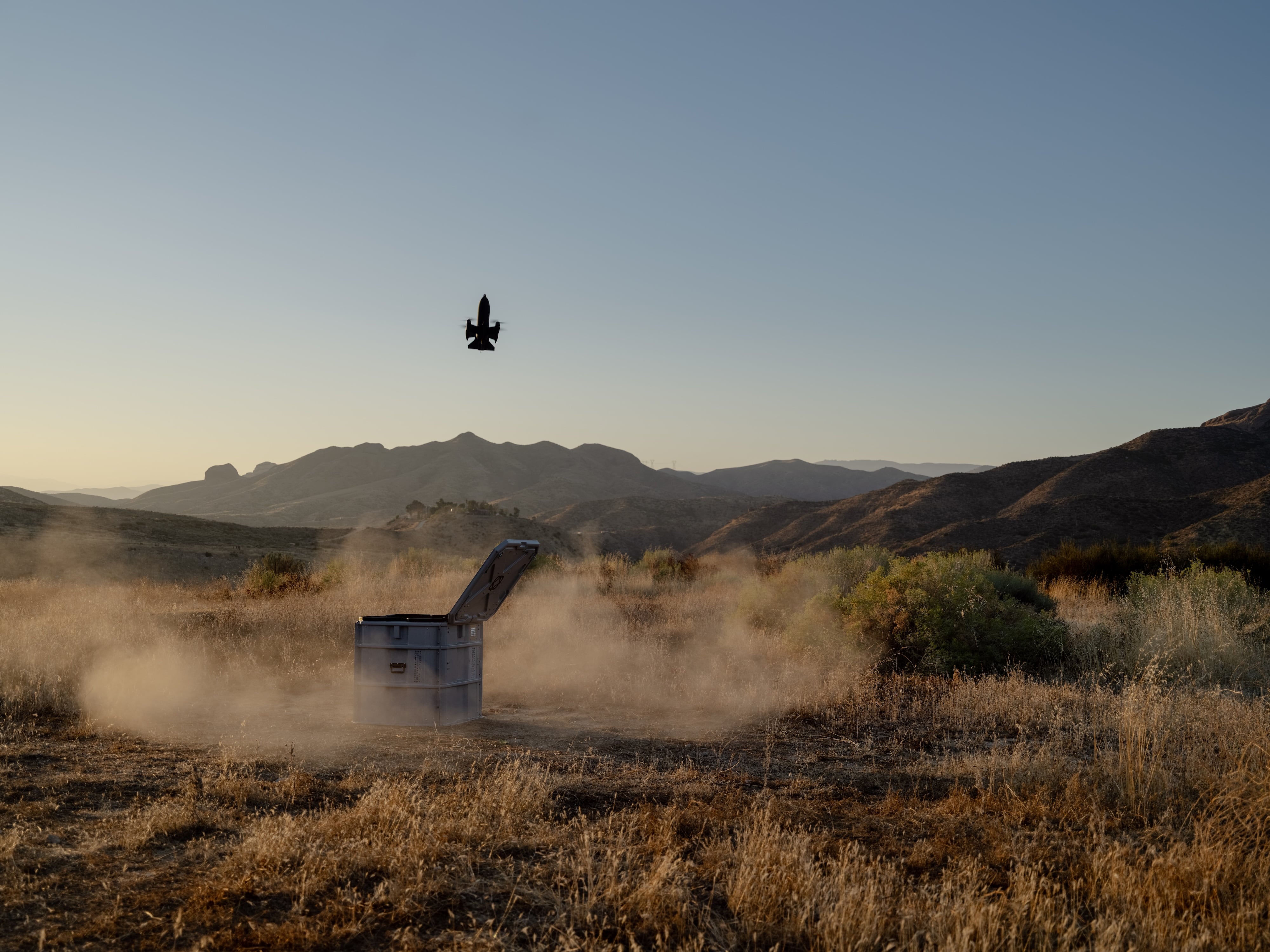
The South Carolina-based startup Powerus unveiled a fully autonomous version of its Guardian interceptor on Monday at the Association of the United States Army’s annual meeting.
Brett Velicovich, the company’s president and co-founder, said in an interview with Military Times that logical product upgrades have been key to the company’s success. He explained how the company’s growth, the evolution of its interceptors and rising U.S. military demand for drone-defense systems amid the war in Iran have converged.
“You know, the U.S. government had a big problem at the beginning of the Iran war, when they sent a bunch of Ukrainian interceptors to the Middle East thinking that it was going to solve a problem,” he said.
According to analysis by the Congressional Budget Office, the U.S. used roughly two-thirds of its inventory of certain missile-defense interceptors by Aug. 1 to stop drones like Iran’s Shahed. Because rebuilding the supply could take years and cost billions, the government has sought quicker and cheaper solutions like those used in Ukraine, but implementing them hasn’t been easy.
“When you go to Ukraine, most of the interceptors, believe it or not, are manually controlled,” he said, explaining that Ukrainian operators are highly skilled at finding and stopping one-way attack drones in the air. “And that’s great for Ukraine, where you could probably throw a rock and hit a drone pilot.”
The problem with the government’s initial thinking, according to Velicovich, was that Ukraine has a “proper drone army,” as the country has “entire brigades that are pilots. So those guys have extreme combat experience in knowing how to take a drone and send it into another drone. In other countries, they don’t.”
With that understanding, Velicovich explained how Powerus provided the U.S. with the Guardian 1 — modeled after manually controlled Ukrainian drone interceptors — to the semi-autonomous Guardian 2, which, when paired with a radar to detect threats, will launch the interceptor in the direction of a drone.
“It’ll know the speed and the telemetry. It’ll launch it in that direction, but you still have to do that final phase of manual kill,” he said.
And finally, Powerus developed the fully autonomous Guardian 3. He explained that when the radar cues it, the system launches in the direction of the threat and can detect and strike using artificial intelligence and navigation systems.
“So you kind of take the human error out of it,” he said.
Velicovich credits this strategy, which he and his team derived from first-hand experience in the military and using drones in combat, to the company’s recent success.
In about one year, Powerus has transformed into a publicly traded company with a market capitalization of nearly $390 million. On Oct. 1, it completed a merger with Aureus Greenway Holdings Inc., a golf course holding company backed by the two eldest Trump sons.
As the U.S. government looks for ways to find low-cost drone interceptors, it’s also looking for low-cost missile interceptors. Power has partnered with the Netherlands-based defense company Destinus to help meet that challenge.
“Destinus brings this just overwhelming, incredible ownership of the technology,” Velicovich said, adding that Powerus will be its “business development channel in the U.S. to sell systems that otherwise had not really been sold here yet.”
He added that Powerus received the demand signal from the Pentagon and aims to deliver.
“We know you’d be crazy not to buy these products because of just how effective they are on the battlefield,” he said.
Daniel Terrill is a contributor to Military Times. He’s been reporting on military issues, the gun industry, and the outdoors for nearly two decades. Although writing is his passion, he’s been a Marine, police officer, and, perhaps the most dangerous job of his career, a substitute teacher.


