WASHINGTON — Coalition airstrikes against the Islamic State group have grown more effective because intelligence has improved, as has training for US proxy forces in Iraq and Syria, the chairman of the Joint Chiefs of Staff said Tuesday.
“If you want to talk about lessons learned, number one is intelligence; If you want to know why our operations are more effective today than they were even a half year ago is because of intelligence has gotten much better
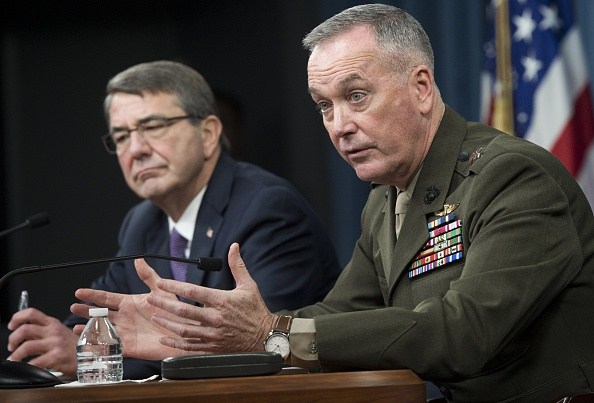
“I’m probably relearning lessons … over the last couple of years, and number one: intelligence,” Marine Gen. Joe Dunford told an audience hosted by the Center for Strategic and International Studies. “If you want to know why our operation’s quantifiably more effective today than they were a year and a half ago, it’s because our intelligence is getting much better.”
“Target development is getting much better, and we relearned some lessons about target development,” Dunford said. “I won’t go into great detail right now, but in terms of how you fully harness the intelligence community — getting the right people in the right places to do target development — has been something that, frustrating to me, we relearned. But over the last several months, I think we’ve made some improvements that result in the progress that we have made.”
“Target development has gotten much better, and to be honest with you, we’ve relearned some lessons about target development,” Dunford said. “Getting the US intelligence community to put the right people in the right places to do target development, has frustrated me, and we’ve relearned it.”
The comments came days after the Pentagon announced the US military killed the Islamic State’s top financier and the group’s minister of war, reportedly by separate airstrikes. Defense Secretary Ash Carter said in a press conference last week, “We are systematically eliminating ISIL’s cabinet.”
Carter said American strikes had targeted a number of Islamic state “associates” and destroyed “a significant quantity of improvised explosive devices and bomb-making equipment” that could have been used against Iraqi forces allied with the US as they try to reclaim the city of Mosul.
There have been some fatal misfires among the nearly 23,000 coalition strikes against the Islamic State. The Pentagon in January reported eight civilian deaths from US airstrikes in Iraq and Syria between April 12 and July 4.
With 100 nations with 30,000 foreign fighters in Iraq and Syria, the US military needs more cooperation from the intelligence organizations of other nations, Dunford said in recent Congressional testimony. Already, he said, there are 15 nations participating in an information and intelligence exchange about foreign fighters.
Dunford on Tuesday said one of the military campaign’s two prongs is killing the group’s leaders and fighters, degrading its capabilities and funding sources. The other is to develop and support proxy forces in Iraq and Syria — though he said the US lacks a “clear partner on the ground in Syria.”
Over the last few months, the US provided improved training for Iraqi and Peshmerga forces in Iraq, and moderate opposition forces in Syria, Dunford said. That training has had a direct impact on the Islamic State’s command and control, resources, weapons and freedom of movement.
Dunford and Carter are preparing to make a series of recommendations to President Barack Obama that the US footprint be expanded as Iraqi forces ready for key offensive to uproot the Islamic State group from its stronghold in northern Iraq.
The U.S. force level in Iraq is officially capped at 3,870. But defense officials say privately the real number is closer to 5,000 when accounting for troops considered to be there on “temporary” deployment.
Email: jgould@defensenews.com
Twitter: @reporterjoe