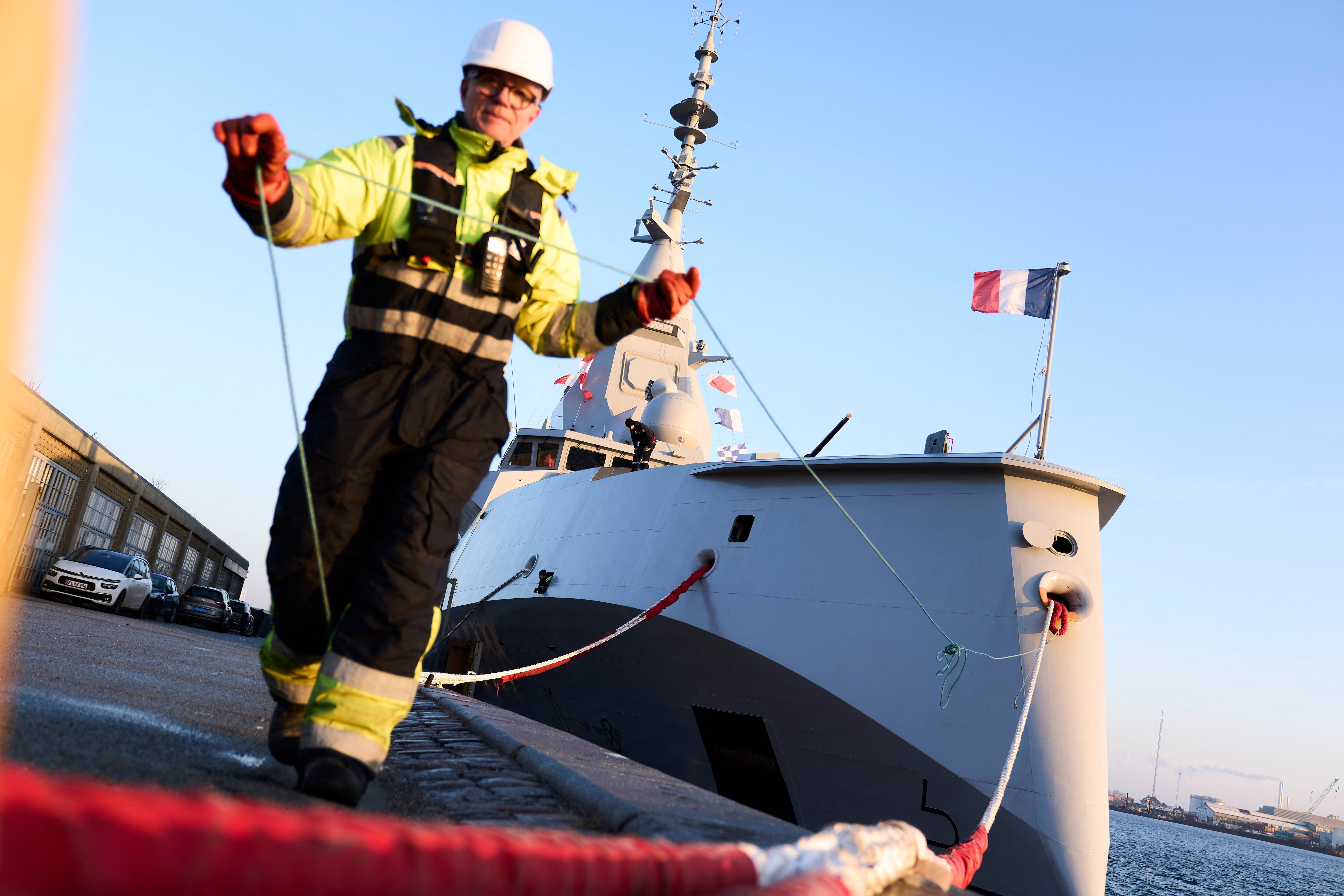
PARIS — France placed an order with shipbuilder Naval Group for the country’s fifth Defense and Intervention Frigate, known by its French acronym FDI and recognizable for its inverted bow, the final vessel currently planned in the class for the French Navy.
The fifth vessel ordered at the end of March will be delivered in 2032, the French Armed Forces Ministry said in a statement late Thursday. France ordered the fourth vessel in the class in December, and both units will be built at Naval Group’s site in Lorient in western France, according to the company.
“The Ministry of the Armed Forces renews its confidence in us to complete the series of defense and intervention frigates,” Naval Group Chief Executive Officer Pierre Éric Pommellet said in a statement. “We are thus fully mobilized to provide the French Navy with the means to achieve naval superiority, in the service of France’s sovereignty.”
Delivery of the last FDI will complete France’s program for a fleet of 15 first-rate frigates, a number that French Navy commander Adm. Nicolas Vaujour has said was dictated by budgetary constraints. Vaujour has maintained his force needs 18 frigates for a “coherent format,” and some lawmakers have been calling to increase the latest FDI order to eight vessels.
The program for the five FDI frigates was budgeted at €4.28 billion ($4.9 billion), according to France’s 2019 accounts. The fifth vessel will be handed over three years later than the original 2029 schedule, in part due to industrial difficulties for the first unit, the Covid-19 pandemic, delays with weapon integration, and reallocation of production slots to accommodate an order by Greece.
The first frigate in the class, the Amiral Ronarc’h, was delivered in October, and is currently on a long-term deployment. The frigate joined the carrier strike group around the aircraft carrier Charles de Gaulle in the north Atlantic in February to test its radars, electronic warfare suite and combat system in a tactical environment.
Naval Group said the FDI can handle rough seas, with the crew of Amiral Ronarc’h “able to observe its aptitude” during trials in Sea State 6 in the Atlantic Ocean. That sea state corresponds to “very rough” conditions with waves of 4 to 6 meters, according to the World Meteorological Organization.
With a length of 122 meters and displacement of around 4,500 tons, the FDI is smaller than new-generation frigates being built or planned in the U.K., Spain, Italy and Germany. The FDIs are designed for high-intensity combat, armed with Exocet anti-ship missiles, Aster air-defense missiles, MU90 torpedoes and a 76 mm cannon, and equipped with a Thales Sea Fire radar with four fixed panels.
Naval Group’s FDI is in competition for a Swedish order for four frigates, with a decision expected in coming months. France has touted its ability to supply a fully equipped and armed frigate in 2030, the target set by the Swedish government for first deliveries, with Naval Group saying in October the yard is able to produce two FDI frigates a year.
Norway in August last year picked the United Kingdom’s Type 26 frigate, primarily manufactured by BAE Systems, over the smaller French design.
Greece in November exercised an option for a fourth FDI frigate, on top of three vessels previously ordered, and in March sent the frigate Kimon, its first vessel in the class, to Cyprus.
While the first two French vessels in the class will be equipped with 16 vertical launch cells due to previously made budget decisions, numbers three to five are to be equipped with 32 cells, similar to the configuration for Greece. The first two frigates will be upgraded to double the number of launch cells at a later stage, according to the government.
France describes the frigate as fully digital, equipped with “significant computer power” to process the information gathered by the vessel’s onboard sensors, as well as a redundant data center.
Rudy Ruitenberg is a Europe correspondent for Defense News. He started his career at Bloomberg News and has experience reporting on technology, commodity markets and politics.