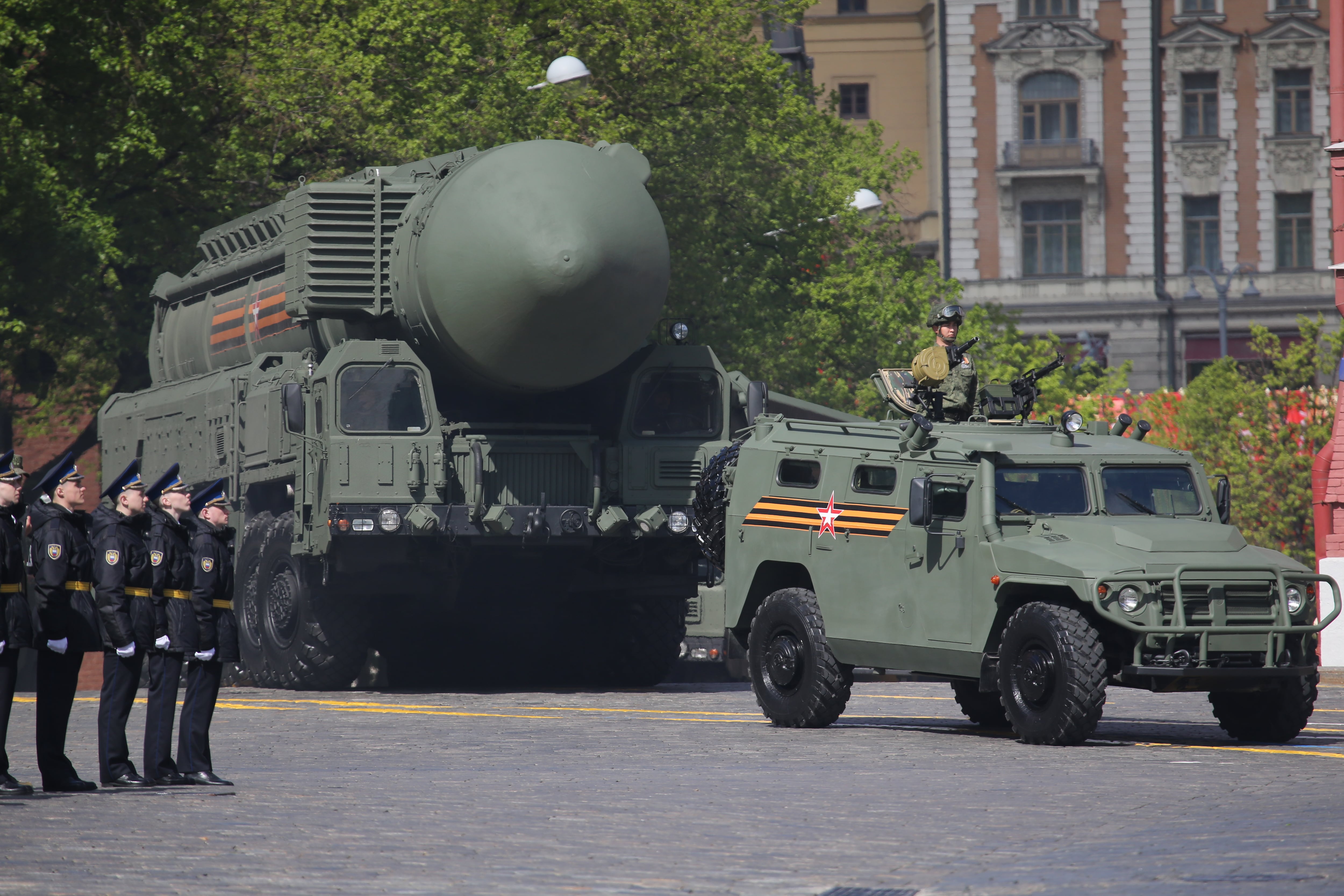
BERLIN — Russian Foreign Minister Sergei Lavrov told the country’s parliament that Moscow will continue adhering to the numerical limits of the expired New START nuclear weapons limitation treaty, provided Washington does the same.
Speaking before the State Duma on Feb. 11, he said: “Our stance is that the moratorium declared by the president is still active, but only if the United States does not surpass the established limits.”
The statement comes less than a week after the treaty expired on Feb. 5, leaving the world’s two largest nuclear arsenals without binding restrictions for the first time in more than half a century. New START, which capped deployed strategic warheads at 1,550 on each side, was signed in 2010 and extended for five years by Presidents Joe Biden and Vladimir Putin in 2021.
President Donald Trump rejected Putin’s proposal for a voluntary one-year extension of the treaty limits, calling New START “a poorly negotiated agreement” and saying he wanted to negotiate a modernized replacement that would include China. Beijing has consistently rejected joining trilateral arms control talks, arguing that U.S. and Russian arsenals far exceed its own.
Meanwhile, some in Russia have pushed for the inclusion of the U.K. and French nuclear arsenals on the Western side of the equation. All major strategic arms reduction treaties to date have been bilateral. To address the stated concerns in Moscow and Washington, a multilateral agreement would be required, a process that experts say could be exceedingly complicated.
Russia suspended its participation in New START in February 2023, citing what it described as the “unsatisfactory state of affairs” with implementation, though Moscow continued to observe the numerical limits. The suspension ended inspections and data exchanges that had provided transparency into both arsenals.
Lavrov’s conditional commitment offers limited reassurance in an environment where verification mechanisms no longer exist. Without inspections or binding obligations, both sides must rely on intelligence assessments to determine compliance − a fragile foundation for nuclear stability as geopolitical tensions remain high over Ukraine and broader strategic competition.
Linus Höller is Defense News' Europe correspondent and OSINT investigator. He reports on the arms deals, sanctions, and geopolitics shaping Europe and the world. He holds a master’s degrees in WMD nonproliferation, terrorism studies, and international relations, and works in four languages: English, German, Russian, and Spanish.