BERLIN — When the Trump administration lifted sanctions on Bosnian Serb separatist leader Milorad Dodik in late October, it marked a dramatic realignment in the Western Balkans that has sparked concerns in Europe that the fragile post-war order in Bosnia and Herzegovina may become shaky.
In the Western Balkan country of three million, where the fateful shots that caused World War I once rang out, there has been a tense stalemate ever since the genocidal fighting of the 90s stopped. A complex framework including 15 parliaments, three simultaneous presidents, and a European peacekeeping force, all imposed by the international community, has kept the country more or less stable but stagnant. A European Union military force with a UN mandate, dubbed Operation Althea, has been keeping the peace on the ground since it replaced a NATO mission in 2004.
But with Trump in charge in the United States, this delicate balance may be upended. With backing from Washington, separatists in Bosnia could be emboldened like they haven’t been in decades.
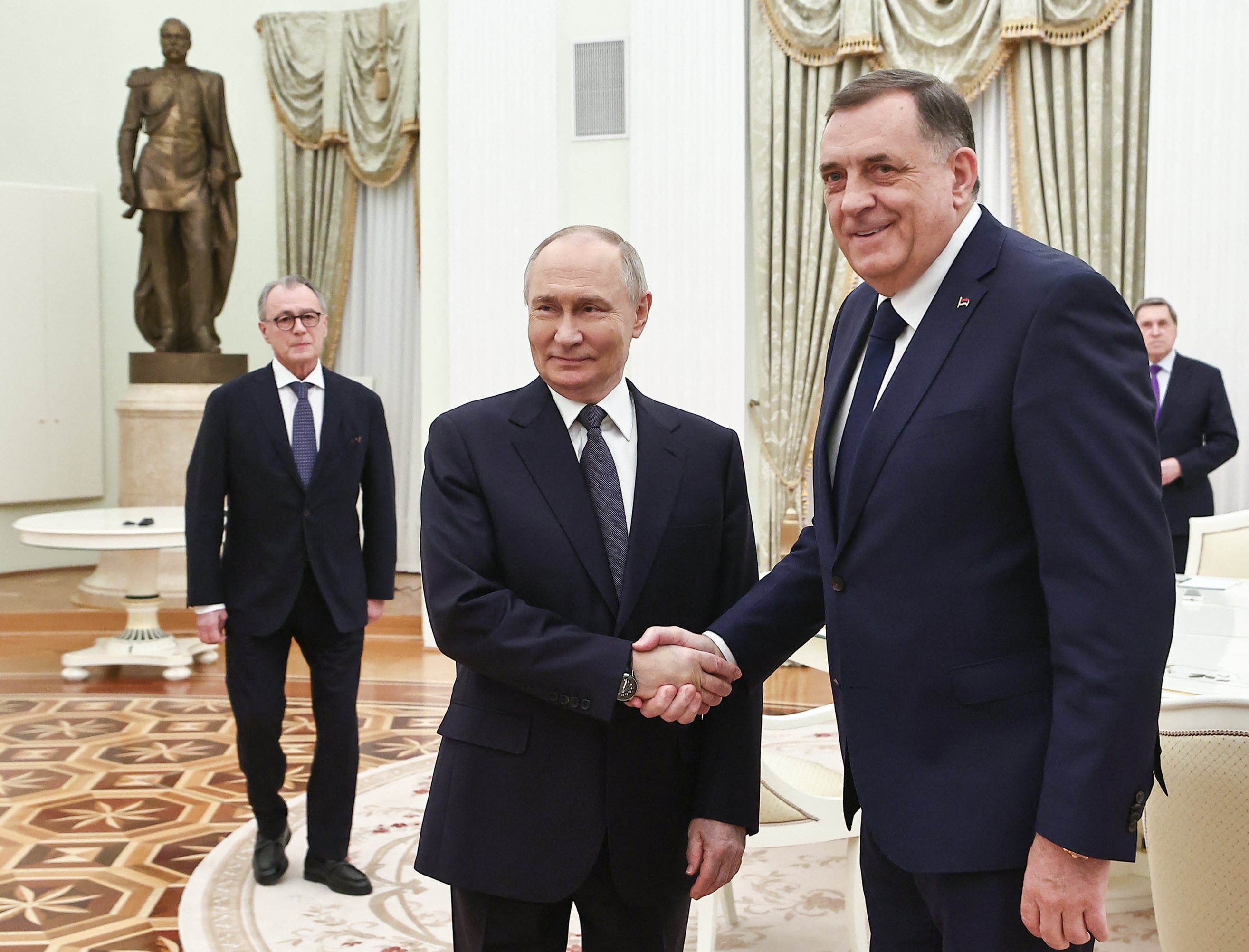
For the first time since the 1995 Dayton Peace Agreement ended Bosnia’s brutal civil war, Washington and Moscow now find themselves on the same side when it comes to Dodik, the nationalist politician who has spent nearly two decades undermining the U.S.-brokered peace deal.
As a consequence, Europe faces a crucial test of whether it can maintain the tenuous post-war security architecture at the heart of the Western Balkans without American backing − and whether it has the political will to do so.
Extensive lobbying pays off
The U.S. Treasury Department’s Office of Foreign Assets Control removed Dodik, his family members, and dozens of associates from its sanctions list on Oct. 29, 2025, reversing penalties imposed for what Washington had previously described as undermining Bosnia’s territorial integrity and the Dayton framework.
Dodik, the leader of the majority-Serb region of Bosnia known as Republika Srpska, has long threatened to secede from the rest of the country, which is Muslim-Bosniak dominated. His administration and allies have enacted a number of power-grab laws that weakened Sarajevo’s ability to exert control over the territory and many of which were deemed illegal by the courts.
The American decision to remove the sanctions followed an intensive lobbying campaign by Republika Srpska authorities, who hired multiple U.S. firms with Republican Party connections after Trump’s reelection, including Becker & Poliakoff, Tactic Global, and MO Strategies.
These contracts, filed under the Foreign Agents Registration Act and first reported by Bosnian media, aimed to “initiate and promote dialogue between the authorities in Republika Srpska and the Trump administration.”
Among those who lobbied for sanctions relief were disgraced former Illinois Governor Rod Blagojevich, whose prison sentence Trump commuted in 2020, as well as Trump associates Michael Flynn and Rudy Giuliani. Right-wing influencer Laura Loomer also pushed for the sanctions to be lifted.
“Some of these were quite short-term contracts,” said Kurt Bassuener, senior fellow at the Democracy for the Balkans Initiative, referring to the lobbying efforts. “The asks were for, you know, to get these sanctions lifted.”
The U.S. Treasury provided no official explanation for the reversal in policy at the time. The State Department characterized the move as a response to “constructive actions,” including the annulment of some separatist laws and Dodik stepping aside after being banned from politics.
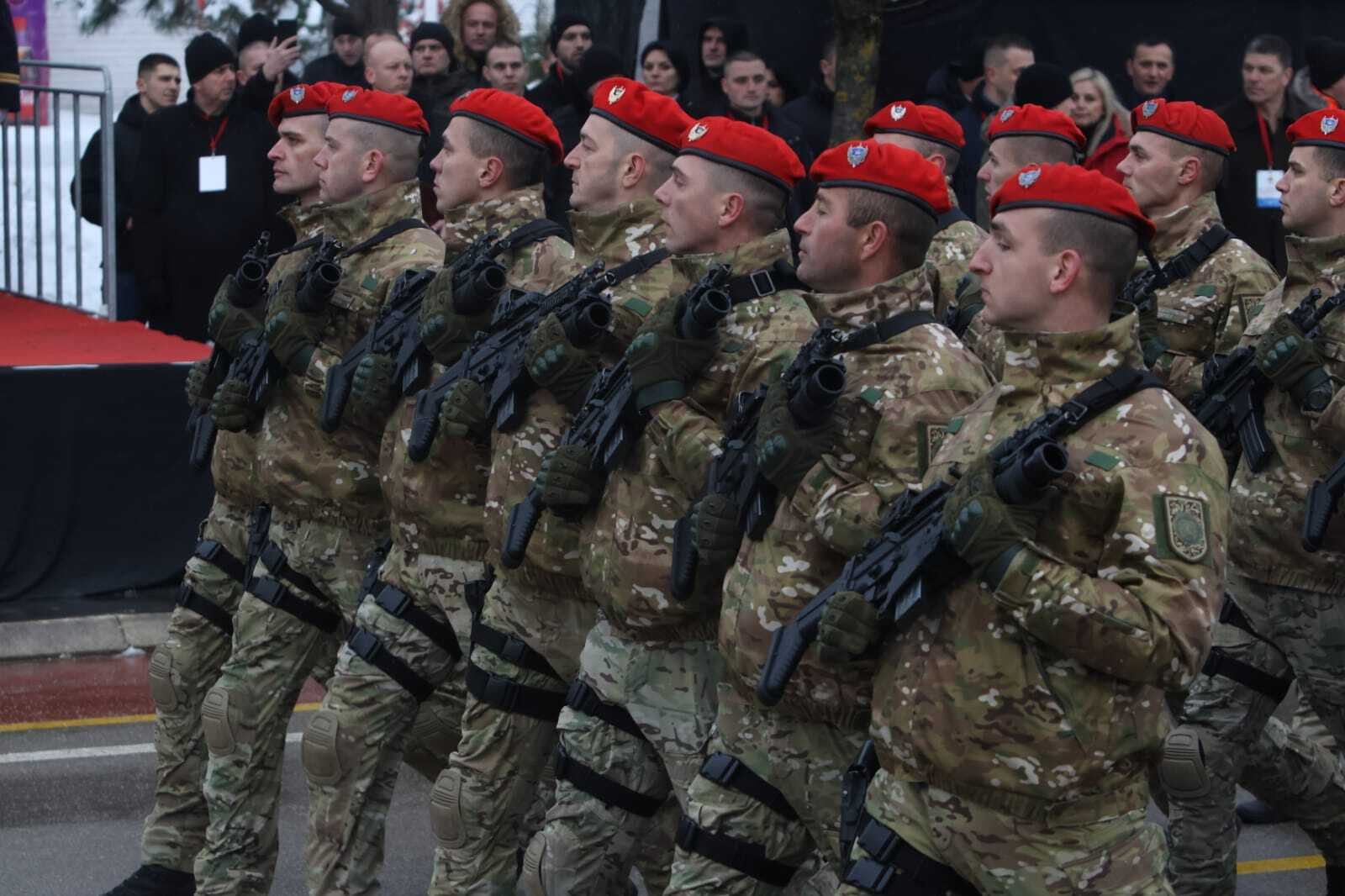
Just a few months after sanctions were lifted, a military-style parade was held in Banja Luka, the capital of the would-be breakaway region. Dodik used the celebration on Jan. 9, which Bosnian courts prohibited for being unconstitutional, for a martial speech.
“Do they truly believe we will comply?” he asked. “Do they think we are intimidated? History does not belong to the fearful.”
Bassuener, who has previously worked as a policy analyst for the international office overseeing Bosnia’s peace deal, said: “He’s already gone right back to his escalatory hate speech, talking about Muslims, talking about Bosniaks as Turks, all this kind of stuff.”
Despite stepping down as Republika Srpska president in June 2025 following a court ruling that barred him from office for six years, Dodik has maintained effective control over the entity’s politics. His chosen replacement from the ruling SNSD party, which Dodik controls, Siniša Karan, won a November 2025 special election with 50.39% of the vote.
In his social media response to the sanctions relief, Dodik thanked Trump “for correcting a grave injustice” and called the decision “a moral vindication of the truth about Republika Srpska.”
Russia holds fire on veto threat
The American reversal on Dodik aligned with another surprise development: Russia did not veto the renewal of the European Union Force Althea when the U.N. Security Council voted unanimously on Oct. 30 − just one day after the sanctions were lifted − to extend the peacekeeping mission’s mandate for another year.
Before the vote, concerns were swirling that Moscow may choose to block the mission’s renewal, continuing its pattern of obstructing international oversight in Bosnia and beyond. Instead, Russian representatives continued their rhetorical attacks on the Office of the High Representative − the international watchdog with sweeping powers to impose laws and remove officials in Bosnia − while allowing the military mission to proceed.
“One idea is they don’t think that the EU will reinforce it to be a truly credible deterrent,” Bassuener said on the Russian calculus. “There’s a sense that once the Europeans dodge the bullet [of a Russian veto], it’ll be more business as usual.”
Russia may also calculate that it can achieve its destabilization goals through other means while its military is tied down in Ukraine, Bassuener suggested. “I think now they can count on their very close partnership with Dodik.”
EU foreign affairs chief Kaja Kallas acknowledged the precariousness of the situation when asked by Defense News shortly after the vote. “The mandate is now extended for one more year, and then comes the question what’s next,” she said, adding that “so far, there hasn’t been a veto by Russia and there are different reasons for that.”
Kallas, who visited EUFOR troops in Bosnia two weeks before the mandate vote, said that the Western Balkans being the EU’s closest neighborhood meant stability there was “very important.” Asked about what steps Europe would take ahead of the next vote to prepare for a potential veto, Kallas said that she planned to visit other parts of Bosnia “to see what more can we do in order to actually break the tensions down.”
Europeans left to hold the line
At the Security Council meeting, Britain and Denmark delivered strong statements in support of the High Representative’s office, while France offered more measured backing. The U.S. representative expressed opposition to “nation building” and called for compromise among Bosnia’s ethnic groups, breaking with longstanding bipartisan U.S. rhetoric on the implementation of the Dayton accords.
The U.S. doubled down through its ambassador in Croatia, Nicole McGraw, at a celebration for the 30th anniversary of the peace deal that ended the Bosnian civil war. McGraw said that Washington is “no longer pursuing ‘nation-building’ or strong interventions” in Bosnia, instead emphasizing the need for “local solutions and local leadership.”
The policy shift in Washington has left the European Union in the uncomfortable position of being the primary international actor trying to preserve Bosnia’s constitutional order, without the full American support they have grown accustomed to over the three decades since the peace deal was signed.
Kallas visited Sarajevo immediately after the mandate renewal, telling officials that “we will not allow history to repeat itself.” She emphasized that international supervision should be phased out only when domestic authorities demonstrate the capacity to govern effectively.
But European officials face significant obstacles. The EU military mission currently maintains approximately 1,600 troops in Bosnia, far below the brigade-level force of around 4,800 troops that military professionals have recommended.
“What I’m not seeing anywhere is a strategy to get out of the dead end that we’re in,” Bassuener said. The question now is whether Europeans are bold enough to reinforce the mission and potentially stay even if Russia eventually vetoes a mandate renewal, he said.
Strategic implications
Bosnia’s instability sits in the heart of the Western Balkans, a region where the EU has long sought to extend its sphere of influence through eventual membership for all six countries.
“This is the one area on Earth where the EU can be a decisive geopolitical actor,” Bassuener said. “But it refuses to use its full toolbox. It prefers to stick to the enlargement model, which mainly deals with trying to induce people to do the right thing through money.”
“It has two sides,” Kallas told Defense News. “One is of course the military presence so that things don’t go out of hand, but the other hand is the political side, which is really to help them with the EU enlargement process, to help them to really work together so that the tensions are down.”
According to Bassuener, Dodik has made two fundamental bets that have proven right so far. “One is that the international community will not align strongly enough and resist him hard enough to force him to back down,” he said. The second bet is that the Bosniak community would be too divided to resist him effectively.
Linus Höller is Defense News' Europe correspondent and OSINT investigator. He reports on the arms deals, sanctions, and geopolitics shaping Europe and the world. He holds a master’s degrees in WMD nonproliferation, terrorism studies, and international relations, and works in four languages: English, German, Russian, and Spanish.