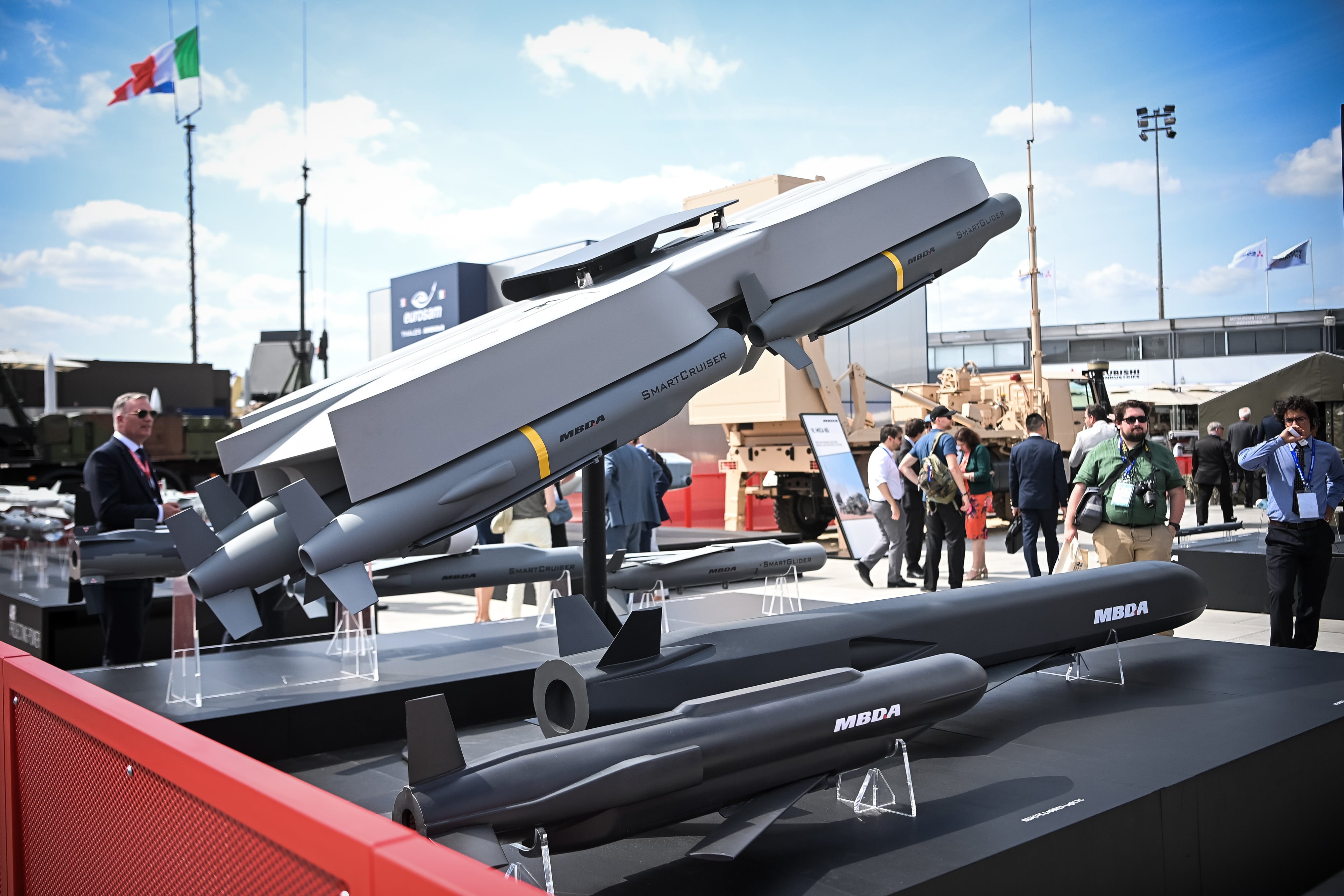
PARIS — The European Defence Fund plans to allocate €1 billion ($1.2 billion) in funding for defense research and development in 2026, with the biggest chunk of money budgeted for work on air and missile defense, including countering hypersonic glide vehicles.
The EDF annual work program includes €168 million for hypersonic counters and high-end endo-atmospheric interception, the European Commission wrote in a call for proposals published Wednesday. The other big-ticket item is ground combat, with €150 million for work on future main battle tank platforms and a multiple rocket launcher.
The fund was set up in 2021 to back collaborative defense R&D by European Union members and has so far invested around €4 billion in more than 200 projects. Some EDF-backed projects address critical capability gaps, such as Odin’s Eye II to build a satellite-based early warning system, or work that would be challenging for a single country to manage, such as hypersonic defense.
“Europe must strengthen collaboration in defense, with the European Defence Fund acting as a key foundation for this effort,” European Commissioner for Defence and Space Andrius Kubilius said. “For the sixth time, we are investing significant resources to incentivize and support research and development on major defense capabilities.”
The EDF has helped reduced duplication and boosted pan-European cooperation, but needs procedural simplification and closer integration with national planning, according to an interim evaluation by the European Parliamentary Research Service published in October.
Half of the 2026 EDF budget is earmarked for major defense capabilities, including developing an EU endo-atmospheric interceptor, a main battle tank, multiple rocket launcher and key technologies for next-generation air fighters, the commission said. A quarter will go to future defense technologies such as quantum-secured networks, artificial intelligence and robot and drone swarms.
The 2026 work program includes €125 million to develop future main battle tank systems with more survivability, superior firepower and the ability to operate with reduced crews and, later on, unmanned. Existing EU tank fleets are aging, and new MBT technologies need to be developed and tested in all future scenarios to maintain a technological edge, the commission said.
The EDF is budgeting €100 million for high-end endo-atmospheric interception, building on previous work to mature key technologies to technology readiness level 6 and develop demonstrators for areas including the interceptor air frame, propulsion and lethality.
The fund will also directly award an indicative €68 million, without a new call for proposals, to continue work on building, testing and flying a basic hypersonic glide vehicle demonstrator as part of efforts to counter the threat, with the work subject to EU secrecy requirements. Companies involved include MBDA, Airbus, Diehl, Hensoldt, Kongsberg, Indra Sistemas and Saab.
The EDF work program includes €90 million to study designs and enable prototypes of medium-sized, semi-autonomous surface vessels for defending coastal waters. The technology should be adaptable for new naval-warfare missions in the future.
Next year’s budget further includes amounts of €20 million to €30 million for programs including a turbofan engine in the 25-35 kilonewton thrust range to power an unmanned loyal wingman aerial vehicle; radar to track unmanned hypersonic vehicles; automated air-to-air refueling; “enhanced cognitive EW” that uses AI to identify and respond to threats; and a multiple rocket launcher.
Rudy Ruitenberg is a Europe correspondent for Defense News. He started his career at Bloomberg News and has experience reporting on technology, commodity markets and politics.