ROME — As the European Union edges closer to mounting a military mission against human traffickers in Libya, and as impressive naval firepower arrives in the Mediterranean for the task, the rules of engagement appear to be getting increasingly vague.
"There is huge confusion over a possible mission, with conflicting positions being taken inside Europe," said Nicola Pedde, the director of the Institute for Global Studies in Rome.
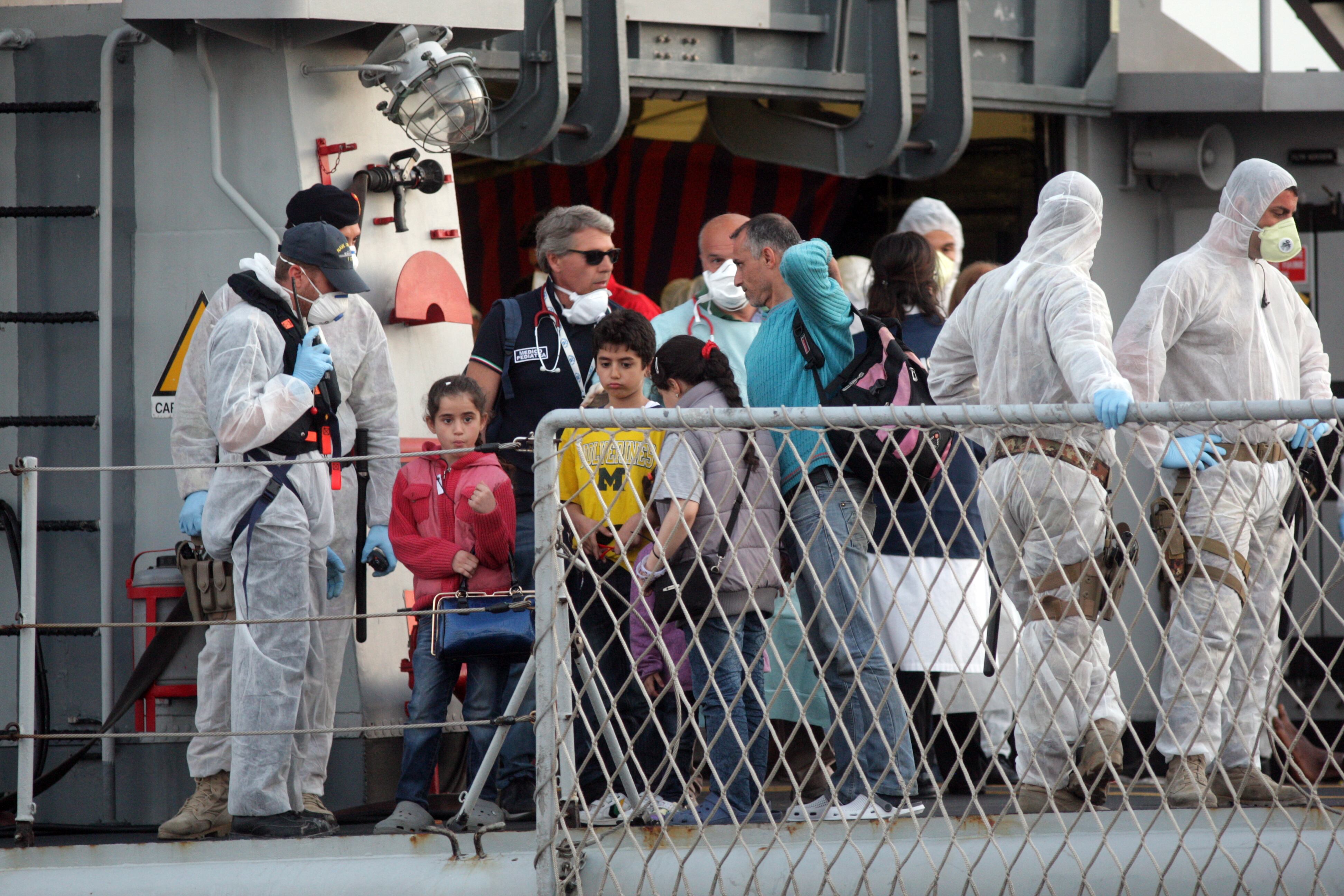
With the number of migrants and refugees from Africa and Syria crossing from Libya to Italy this year topping 40,000, European governments have agreed to put a halt to the traffickers who make millions of dollars packing migrants into old fishing boats and dinghies for the crossing.
The traffickers have squeezed so many migrants into the lower decks of fishing boats that many have died from suffocation and inhaling fuel fumes, while boats often sink, with about 5,000 drowning in the last year and a half.
Last month, European leaders held an emergency summit after one boat capsized and sank, drowning around 750 migrants on board. In addition to As well as beefing up an existing search-and-rescue operation in the Mediterranean, leaders backed military intervention against the traffickers, who are suspected of having links with armed militias, including ISIS, now running fiefdoms in lawless Libya.
Roberta Pinotti, Italy's defense minister, summed up the bullish mood when she said, "We know where the smugglers keep their boats, where they gather," adding, "the plans for military intervention are there."
The EU foreign policy chief, Federica Mogherini, then flew to New York to brief the UN Security Council and ask for the UN's blessing for the mission, which has yet to be given, with Russia reportedly reluctant to sanction land operations.
Mogherini has said there would be no "boots on the ground" in Libya, but a draft 19-page EU document, circulated on May 13, took an aggressive stance.
The document stated that "A presence ashore (in Libya) might be envisaged if agreement was reached with relevant authorities," and raises the possibility of seizing or destroying fuel dumps and embarkation facilities on Libyan soil.
"Action taken ashore could be undertaken in a hostile environment," the document adds, stating that the "terrorist presence in the region" constitutes "a security threat."
The mission would also involve seizures of boats at sea that are due to be used by traffickers, the document stated, requiring aircraft, amphibious ships and intelligence, in the face of a potentially "robust threat" from coastal artillery batteries set up by Libya-based militias.
The documents warn that boarding ships to arrest traffickers while migrants are on board would involve "a high risk of collateral damage including the loss of life."
At a meeting of EU foreign and defense ministers on May 18, Italy was given the task of leading a mission and Italian Navy Adm. Enrico Credendino was named as the Italian candidate to take charge. The HQ will be Italy's joint forces command center at Centocelle in the outskirts of Rome.
The UK Royal Navy assault ship HMS Bulwark, which is already in the Mediterranean helping save migrants, could turn its attentions to targeting traffickers should the operation start.
But ahead of a final EU decision and a pending UN green light, analyst Pedde said Rome was not convinced about the operation.
"Any intervention risks provoking confrontation with the militias in Libya and I do not think Italy is willing to face that," he said. Pedde said the existence of two rival governments in Libya, one in Tripoli and one in Tobruk, had created a "phase of deep ambiguity" for Italy.
Italy, he said, officially supported Tobruk, which has the backing of the West, but was "reluctant" to support Gen.eral Haftar, the military commander campaigning on behalf of Tobruk. "Meanwhile, Italy has ties with Tripoli," he added.
The key issue remains whether commandos can mount raids on trafficker boats waiting in ports to be used. In addition, the fishing boats bought from fisherman to be loaded with migrants tend to change hands fast, making it difficult to know when to sink them. Rigid hull dinghies are also employed, but are reportedly buried in the sand until the moment they are used.
Traffickers rarely accompany the migrants on their voyages, preferring to train up migrants to take the helm, reducing the chances of them being arrested at sea. ing them at sea.
One stumbling block that may be overcome before June is winning permission for operations from the rival governments in Libya. Italian media reported on May 21 that the Tobruk government had signaled its willingness to work with Europe to tackle traffickers, while Tripoli has been showing signs of goodwill toward Europe of late by arresting migrants before they sail, after ignoring the trafficking trade.
On May 21, Italian defense minister Roberta Pinotti appeared convinced the operation would proceed.
"Italy is doing diplomatic work at the UN Security Council to reach a resolution which permits military intervention," she said, adding that officials wanted the operation ready to start by a European leaders' summit in late June.
Email: tkington@defensenews.com
Tom Kington is the Italy correspondent for Defense News.