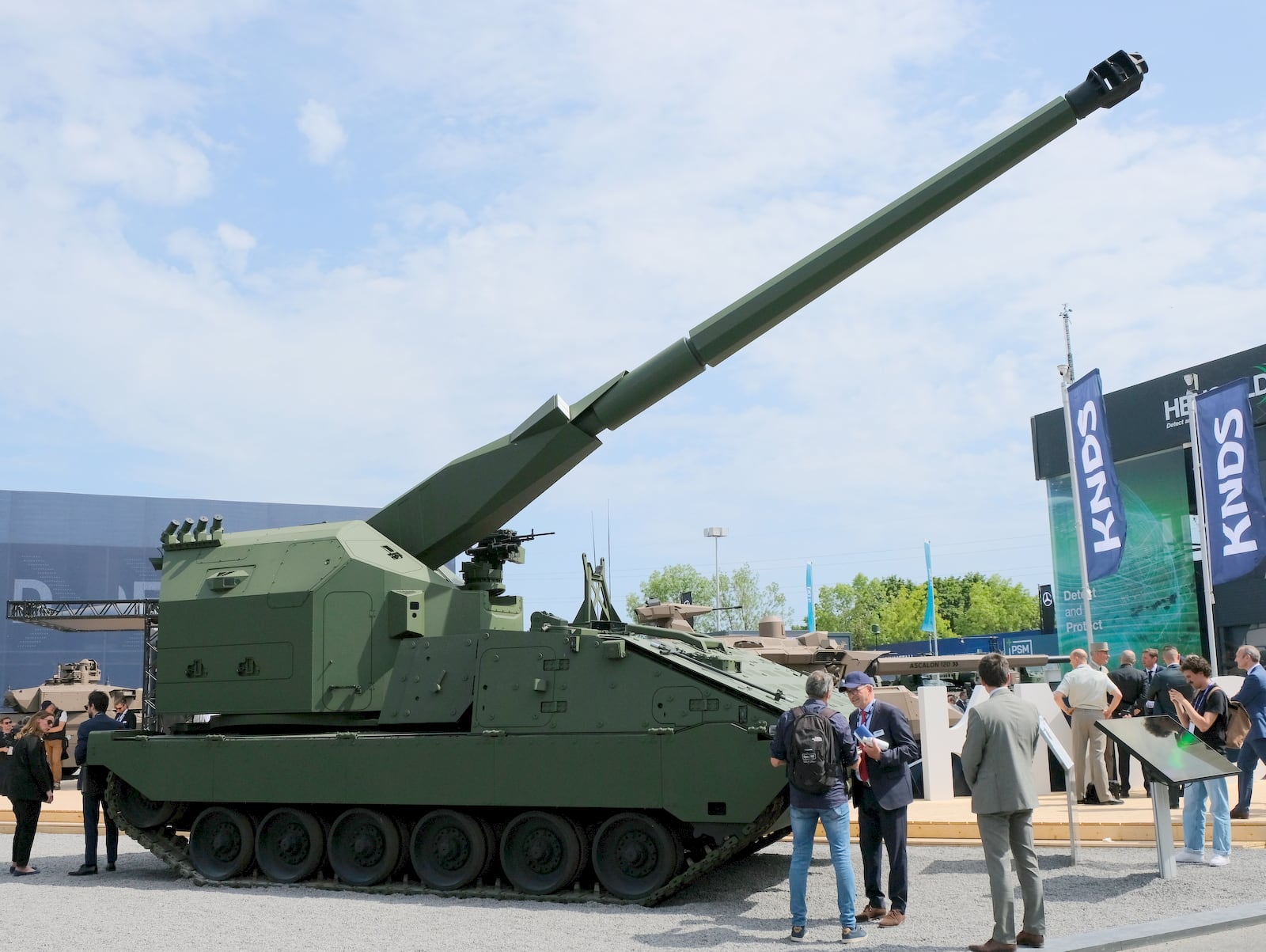
PARIS — KNDS, the French-German maker of the Leopard tank and the Caesar truck-mounted gun, pitched a new howitzer with a barrel longer than any NATO production artillery, which the company said gives the weapon a range of up to 60 kilometers (37 miles) with standard high-explosive shells.
The howitzer uses KNDS Germany’s Artillery Gun Module mounted on a tracked Boxer chassis and fitted with a French barrel. The company has already fired a prototype of the gun, and aims for serial production between 2032 and 2035, KNDS France artillery engineer Pierre Septfons told a handful of journalists in a briefing at the Eurosatory defense show near Paris on Monday.
The 155mm howitzer, named Loras for long-range artillery system, is equipped with a 58 caliber gun tube, about 12% longer than the 52 caliber barrels that equip most recent European cannons and compared with 39 caliber for the United States’ M109 Paladin. Longer barrels translate into longer range, and KNDS is also increasing the maximum powder charge to propel shells even farther.
“The goal was to be able to do 60 kilometers using conventional ammunition, so as not to have to use rocket-assisted projectile munitions,” Septfons said.
The base range of 52 caliber guns firing 155mm munitions is roughly 40 kilometers.
KNDS is self-funding development of the howitzer and the associated munitions, though the company received some help from France’s Directorate General for Armament in early-stage studies “to reassure us that we were on the right track,” according to Septfons.
The U.S. scrapped its Extended Range Cannon Artillery program in March 2024 after the prototype ERCA howitzer fitted with a 58 caliber barrel suffered excessive wear of the gun tube despite a relatively limited number of rounds fired.
While barrel wear increases with length due to greater forces, the KNDS gun has a larger combustion chamber than the ERCA howitzer, with a “much gentler pressure curve,” Septfons said.
European artillery makers have steadily continued to develop 52 caliber guns, creating a body of expertise that better equips them to mitigate barrel wear, the engineer said.
Loading in the Loras is fully automatic, though the gun’s automation is more recent than that of the Panzerhaubitze 2000, according to Septfons. Operational reports from Ukraine have indicated lower availability rates for some of the fully automated howitzers in battlefield conditions compared to more simple systems such as the Caesar.
While the AGM incorporates some elements of the Panzerhaubitze, particularly for shell loading, the overall system is “much newer,” with up-to-date electronics and a brand new loading mechanism, Septfons said. The barrel is produced at KNDS France facilities in Bourges in central France, and the cost is “marginally more” than for a 52 caliber barrel, the engineer said.
The Loras gun will be able to take between one and eight modular propellant charges, compared with between one and six for the Caesar. The gun could reach distances of around 100 kilometers with ramjet-propelled or gliding munitions, though KNDS plans to focus on basic munitions, and cooperate with partners who want to develop more advanced shells, Septfons said.
The Loras will be able to fire standard 52 caliber shells but won’t necessarily fire farther with those, and KNDS is developing a range of specific munitions for the 58-caliber gun, according to Septfons.
“The idea here is to have a complete family of conventional shells, including high-explosive, illumination, and smoke rounds, that can harness the gun’s full potential and fire up to 60 kilometers,” the KNDS engineer said.
“For now, we’re really focusing on conventional munitions, and the idea is to be open to partnerships with other manufacturers” for munitions such as ramjet-powered shells, Septfons said.
Rudy Ruitenberg is a Europe correspondent for Defense News. He started his career at Bloomberg News and has experience reporting on technology, commodity markets and politics.