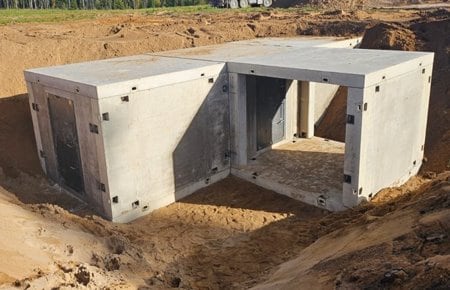
BERLIN — Estonia has started public procurement of 600 modular bunkers as part of a joint push by the Baltic states to secure their long border with Russia and Belarus, marking a crucial next phase in the region’s ambitious fortification drive.
The Estonian Centre for Defence Investments announced the competitive negotiated procurement on Feb. 19, seeking companies capable of manufacturing and delivering large quantities of concrete structures to Baltic Defence Line storage areas. The tender has been published in the Estonian Public Procurement Register.
The Baltic Defence Line is a joint initiative of Estonia, Latvia and Lithuania designed to ensure military defense from what officials describe as “the first meter of national territory.” It’s a real-world reflection of NATO’s doctrinal departure from earlier thinking that had tolerated trading Baltic territory for time, pending reinforcement from allies.
Latvia’s Ministry of Defence has expressed interest in joining the bunker procurement and is in talks with Tallinn about potential involvement, Estonian officials said. Though the Baltic Defense line is a joint project across Estonia, Latvia and Lithuania, the procurement and construction work under the project has largely been independent.
Asko Kivinuk, deputy director general of the ECDI, pointed to the economic logic of Baltic cooperation. “A joint procurement enables cost savings through economies of scale,” he said. Estonia has allocated €60 million ($71 million) to the project.
“The first bunkers for the Baltic Defence Line have already been delivered, and their installation is progressing step by step in Southeast and Northeast Estonia,” Kivinuk said. “The experience gained gives us the confidence to move forward with a larger-scale procurement.”
Estonia says all previously acquired “counter-mobility assets” have been positioned in pre-designated storage areas. Work on an anti-mobility trench system is also underway. ECDI’s stated goal is a speedy completion of the Baltic Defence Line by the end of 2027.
Defense News reported in December that Estonia had deployed the first five bunkers along the line, a symbolic milestone aimed at gaining experience with the quick and effective deployment of the modular buildings.
At the time, Estonian officials said in an interview that there were unanticipated challenges with terrain, land ownership, and production costs that had to be ironed out before full-scale construction could commence.
Estonian media report that nine bunkers have been installed to date.
Linus Höller is Defense News' Europe correspondent and OSINT investigator. He reports on the arms deals, sanctions, and geopolitics shaping Europe and the world. He holds a master’s degrees in WMD nonproliferation, terrorism studies, and international relations, and works in four languages: English, German, Russian, and Spanish.