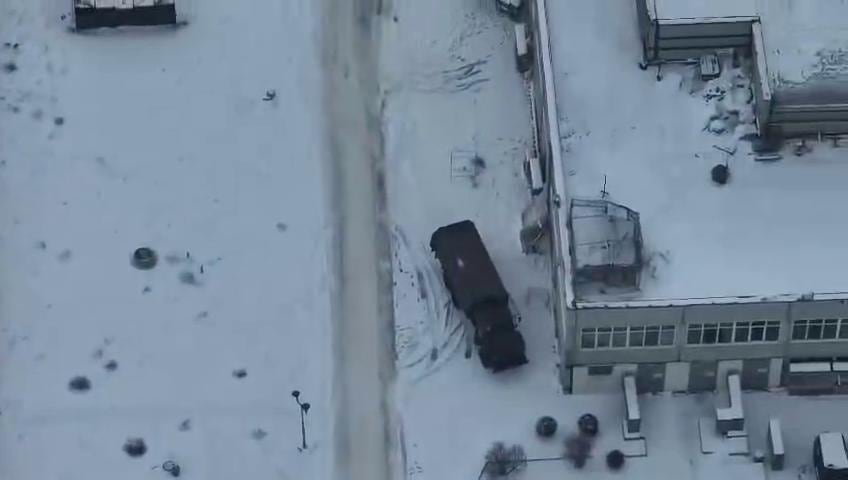
BERLIN — An aerial video from Zaporizhzhia Nuclear Power Plant in Russian-occupied Ukraine appears to show Russian military trucks parked in the facility, in what would likely be a breach of international law.
Defense News was able to independently geolocate the video to the Zaporizhzhia nuclear power plant in the city of Enerhodar, which has been occupied by Russian forces since the full-scale invasion of Ukraine in early 2022. The aerial video, which appears to have been taken from a drone, first appeared online on Wednesday, mid-morning European time. It has since widely been shared in Ukrainian Telegram groups devoted to covering the war and sharing footage of combat.
Several vehicles in military-style paint schemes are visible in the video, parked under a bridge connecting the nuclear reactors and radioactive waste treatment buildings of the power plant, as well as a larger truck parked near a laboratory and services building. It appears to be a KamAZ military truck, though the low quality of the video makes it difficult to identify with confidence.
The snow cover visible in the video is consistent with current conditions on the ground, Defense News confirmed using historic satellite imagery and weather data. Zaporizhia has remained largely snow-cover-free this winter until early this week, indicating that the claims of the video’s recentness are accurate.
Among the accounts that have shared the video is Vladyslav Voloshyn, a spokesperson for the Defence Forces of Ukraine. “Knowing that we will not fire at the nuclear power plant, the Russians hide their military equipment here,” he said in his post. “They use the territory and facilities of the ZNPP as a training ground for their UAV operators. There is even evidence that MLRS attacks on Zaporizhia were carried out from here several times.”
Defense News was unable to independently verify these claims.
The Zaporizhzhia power plant, Europe’s largest nuclear generating station, remains in a cold shutdown, meaning the nuclear chain reaction has been halted, and no electricity is being generated. However, the nuclear fuel remains on site and must be cooled in order to avoid a potentially catastrophic meltdown. For this, the plant’s pumps require a reliable supply of electricity, which comes from the outside power grid and backup generators.
Militaries are generally prohibited from storing military logistics vehicles and equipment at nuclear power plants under international humanitarian law. Article 56 of Additional Protocol I to the Geneva Conventions specifically requires parties to armed conflict to “endeavor to avoid placing military objectives, such as troops, weapons or military vehicles, in or near nuclear power plants.”
Nuclear power plants also are afforded special protections and must not be attacked “if such attack may cause the release of dangerous forces and consequent severe losses among the civilian population,” as is prescribed in the Geneva Conventions.
Throughout the war, Russia has been accused repeatedly of misusing the premises of the nuclear power plant to station military equipment and store ammunition.
Following a September 2022 inspection mission, the International Atomic Energy Agency, the international nuclear watchdog, explicitly stated that “the team observed the presence of Russian military personnel, vehicles and equipment at various places at the [power plant], including several military trucks on the ground floor of the unit 1 and unit 2 turbine halls,” as well as parked under the overpass connecting the reactor units.
The IAEA has maintained its mission presence at the power plant and continued documenting violations, although its efforts have been hampered by Russian chicanery. In July 2024, when the IAEA sought to confirm reports of land mines and explosives at the nuclear station, Russia specifically denied access to the rooftops of reactor blocks 3 and 4 and parts of the cooling system where military presence had been previously reported.
The power plant has also seen combat action and shelling in its vicinity, which has on several occasions disconnected it from the power grid and forced the use of backup generators.
Linus Höller is Defense News' Europe correspondent and OSINT investigator. He reports on the arms deals, sanctions, and geopolitics shaping Europe and the world. He holds master’s degrees in WMD nonproliferation, terrorism studies, and international relations, and works in four languages: English, German, Russian, and Spanish.