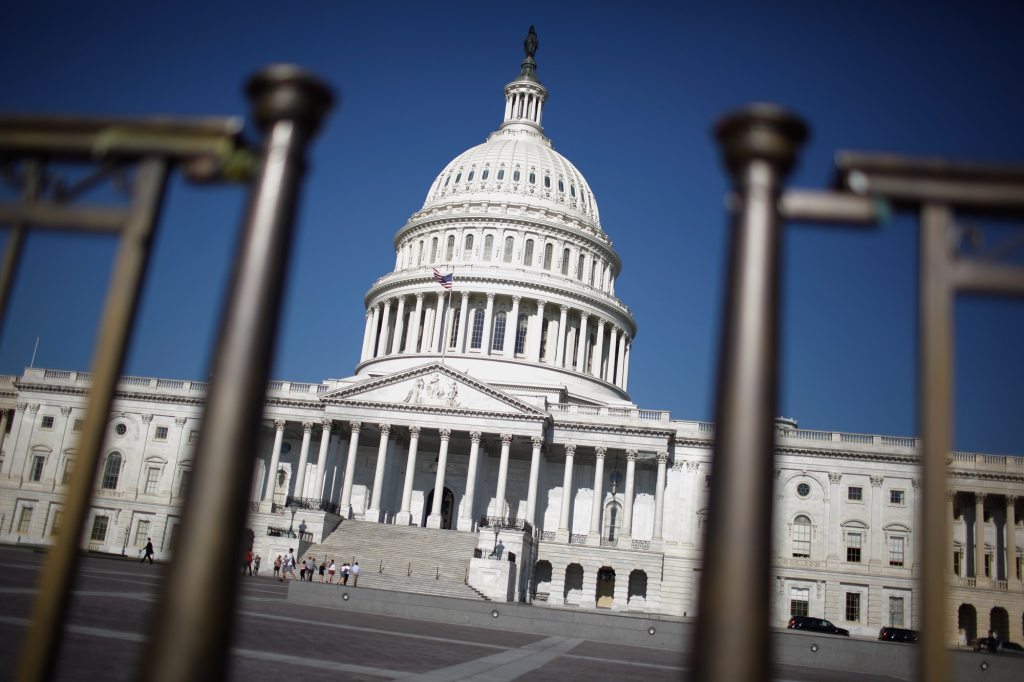
WASHINGTON — US House and Senate conferees finalized a $618.7 billion defense policy bill that strips added jets and ships, but boosts military manpower above President Barack Obama’s budget.
The measure would support ongoing operations overseas, split the chief weapons buyer’s office, cap the National Security Council staff at 200 and raise US Cyber Command from the US Strategic Command to its own combatant command. The bill ditches plans to short war funding for several months and changed policy provisions likely to bait Democratic opposition and the president’s veto.
The 2017 National Defense Authorization Act is expected to go to a House floor vote on Friday and a Senate floor vote early next week.
The NDAA would exclude House provisions for 14 more F/A-18E/F aircraft for the Navy and 11 more F-35 joint strike fighters across the services, and all but a fraction of the $2 billion plus-up to the Navy’s shipbuilding budget.
Instead, the bill aims to roll back the Obama administration’s planned drawdown and adds related operations and sustainment funds to support the added manpower. Army end strength jumps to 476,000, from 460,000 in 2017, and the Marine Corps jumps to 185,000 from 182,000 in 2017.
The general officer ranks would be cut by about 12 percent, the majority of them in joint billets.
“All the procurement that was in the House bill at $18 billion, except for end strength, none of that is in there,” a senior committee staffer said at a Capitol Hill staff background brief late Tuesday afternoon. “The underlying Hornets in the president’s budget, those remain, but the additional ones are not in there.”
A different senior committee aide said the decision to push off the procurement increases was influenced by Donald Trump’s election victory and the prospect of a defense buildup later. The president-elect campaigned on plans to “rebuild” the military with new ships, jets, manpower and a “state-of-the-art” missile defense system.
Aimed at acquisition reform, it would split the duties of the Pentagon undersecretary for acquisition, technology and logistics (AT&L) between an undersecretary for acquisition and sustainment (AT&S), and create a new undersecretary for research and engineering (R&E) — a chief technology officer. Implementation is ordered for February 2018, though the Department of Defense isn’t precluded from implementing it sooner.
“The problem we’re trying to solve is to get the war fighter what he needs, when he needs it — 20-year programs aren’t much help in this modern age,” a senior committee staffer said.
Pentagon officials had pushed back against a similar proposal in the Senate version of the bill, and late Tuesday, DoD spokesman Peter Cook declined to weigh in without having seen the conference report.
“You know the secretary’s concern about the change that had been proposed, in the Senate legislation in particular, and he would continue to have those concerns,” Cook said. “We would like to see the finished product, and we look forward to working with Congress trying to resolve these outstanding issues.”
Senate Armed Services Chairman John McCain and House Armed Services Chairman Mac Thornberry, with the ranking Democrats of each committee — Sen. Jack Reed and Rep. Adam Smith, respectively — finalized the conference report and were expected to continue gathering lawmaker signatures through Wednesday morning. The so-called Big Four did not release the conference report immediately.
It was unclear whether the top Democrats would withhold their signatures in opposition to its funding mechanism. They were still mulling it over Tuesday afternoon, aides said.
The conference report authorizes $543.4 billion base budget top line with $8.3 billion in base requirements funded by the wartime overseas contingency operations (OCO) dollars to skirt statutory budget caps. The NDAA includes $59.5 billion in total in OCO.
That $59.5 billion exceeds the president’s request for OCO for base requirements by $3.2 billion — all dedicated to military readiness. Because this money does not have a match on the domestic side, it may stymie Democrats who have insisted all defense increases be matched on the non-defense side of the federal budget.
“There is still an issue of $3.2 billion that … does not have a match on the domestic side,” a senior Democratic committee staffer said.
The announcement was made, as in years past, under the cloud of a veto threat from Obama and larger uncertainty around the federal budget. Congress is debating extending a stop-gap measure to fund the federal government as late as May. The idea is to allow the incoming Trump administration to make its mark on federal spending.
The bill was stripped of House-generated policy provisions on the sage grouse and workplace protections based on sexual orientation, both of which are likely fueling Democratic opposition. A House requirement for women to register for the draft was replaced by a requirement to study the issue.
Ahead of the news conference, SASC member Claire McCaskill, a Democrat from Missouri, the home of Boeing, called out Republican leadership for not including Growlers, which are made by Boeing.
“I’m not happy the Growlers are not in it. But ultimately that’s an appropriations decision,” McCaskill said. “I’m surprised the House allowed it. The House has a great deal of control right now. [House Speaker] Paul Ryan and the Republicans are in charge. Ultimately the reason they’re not in there is because they didn’t want them in.”
Aaron Mehta in Washington, D.C., contributed to this report.
Email: jgould@defensenews.com
Twitter: @ReporterJoe