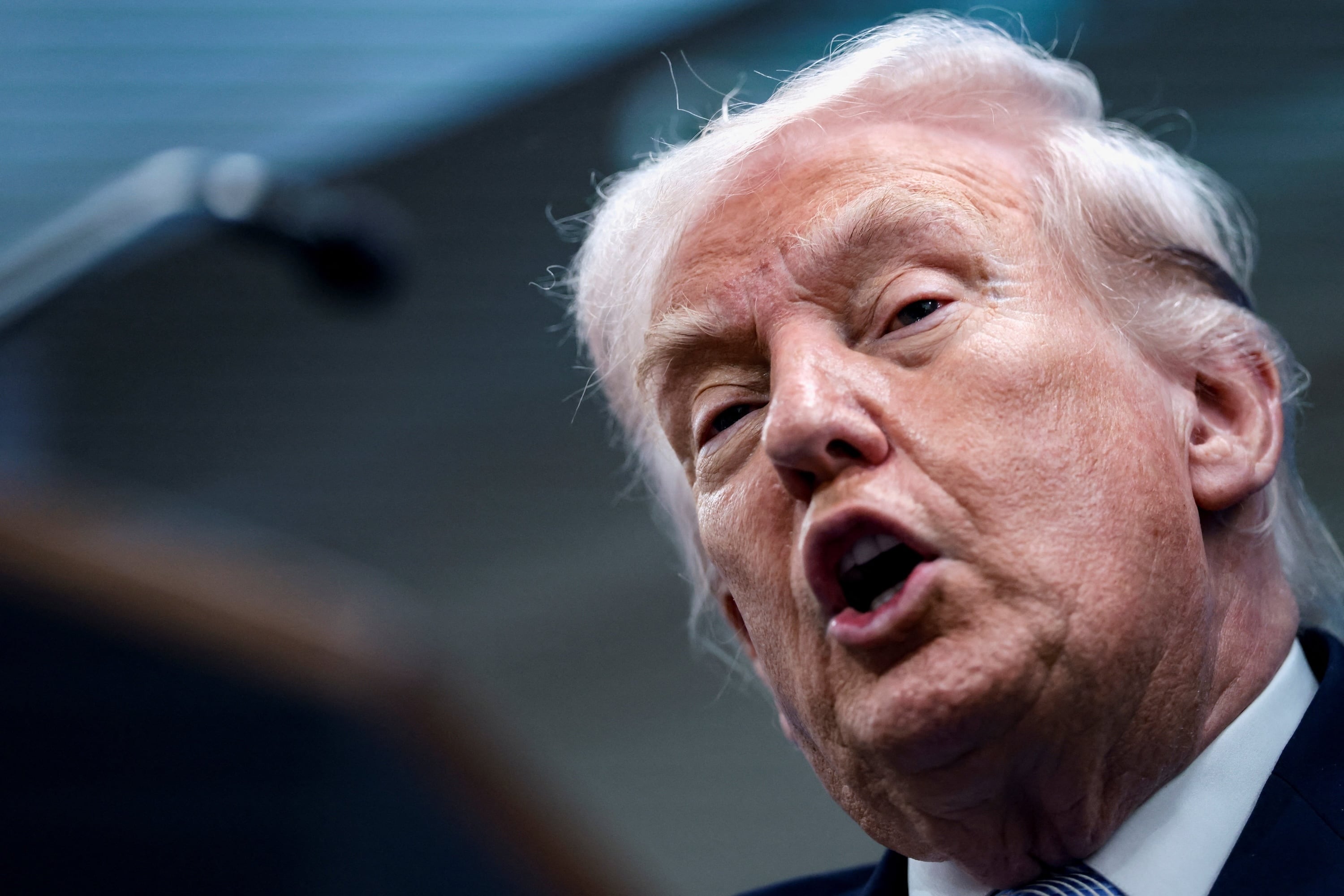
President Donald Trump on Thursday again chided NATO for its reluctance to support U.S. operations in Iran, just a day after a tense private meeting with Secretary General Mark Rutte at the White House.
Rutte travelled to Washington to mollify the president, who remains incensed at the alliance for refusing to intervene in the de facto blockade of the Strait of Hormuz, a critical artery that typically carries a quarter of the world’s oil and gas. The strait’s near-closure has prevented roughly ten million barrels of crude oil daily from reaching global markets.
But Trump, following the face-to-face talks, was far from conciliatory. He wrote on social media Wednesday that “NATO WASN’T THERE WHEN WE NEEDED THEM, AND THEY WON’T BE THERE IF WE NEED THEM AGAIN. REMEMBER GREENLAND, THAT BIG, POORLY RUN, PIECE OF ICE!!!”
In a subsequent post Thursday, he dismissed the response from the bloc as “very disappointing.”
Rutte acknowledged the discord with Trump, yet characterized Europe’s initial reticence to get involved in the war in Iran as a consequence of the president’s decision not to consult allies before the launch of Operation Epic Fury. He said the other member nations were taken by surprise by the joint U.S.-Israeli assault against Iran, and slower to respond as a result.
“To maintain the element of surprise for the initial strikes, President Trump opted not to inform allies ahead of time. And I understand that,” Rutte said during his remarks at the Reagan Institute’s Center for Peace Through Strength in Washington on Thursday.
“But what I see when I look across Europe today, is allies providing a massive amount of support —basing, logistics, and other measures — to ensure the powerful U.S. military succeeds in denying Iran a nuclear weapon and degrading its capacity to export chaos," Rutte said.
The NATO secretary general also underscored international efforts, spearheaded by Britain’s Prime Minister Keir Starmer, to find a workable plan for a full reopening of the strait as hostilities wind down.
“The United Kingdom is leading a coalition of countries that are aligning the military, the political, and the economic tools that will be required to ensure free passage through the Strait of Hormuz. This is evidence of a mindset shift,” he said.
The Trump administration has asserted it will reassess its relationship with NATO once the war with Iran concludes, a review that officials say could include relocating American forces away from allies deemed unhelpful. The president has also weighed the possibility of withdrawing the United States from the alliance altogether.
At a White House press conference earlier this week, Trump traced the start of the icy relations back to Greenland.
The president, around the start of the year, began talking with increasing seriousness about annexing Greenland, the huge, semiautonomous territory under Danish sovereignty. At the apex of the crisis, Trump refused to rule out using military force. He ultimately backed down but the tremors from the episode are still being felt on both sides of the Atlantic.
“It all began with, if you want to know the truth, Greenland,” Trump told reporters on Monday, adding, “We want Greenland. They don’t want to give it to us. And I said, ‘bye, bye.’”
Tanya Noury is a reporter for Military Times and Defense News, with coverage focusing on the White House and Pentagon.