
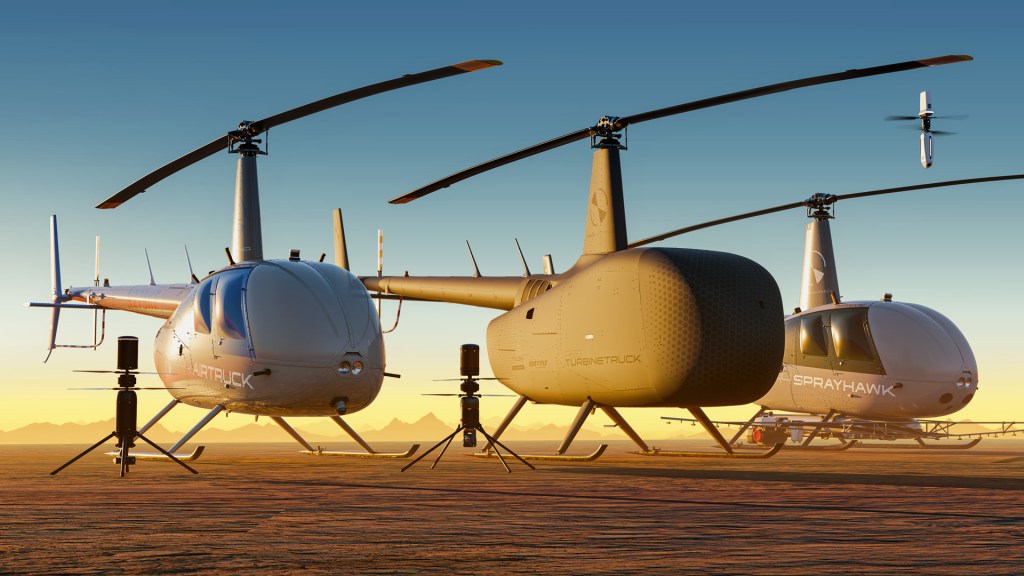

As unmanned systems become central to modern defense operations, the next challenge is not simply how to field more drones faster, but how to build lasting operational advantage. Robinson Unmanned President Paul Fermo discusses why drone dominance requires an ecosystem of adaptable aircraft, from small soldier-deployable systems to full-scale autonomous helicopters, supported by open architecture, scalable production, and the discipline of certified aircraft manufacturing.
Q: The defense community is moving quickly to field more unmanned systems. What is the most important part of that conversation?
Paul Fermo: Speed and quantity matter. Modern conflict has shown how important unmanned aircraft can be for immediate situational awareness, targeting, force protection, logistics and resupply, and missions that reduce risk to operators.
But drone dominance is not just about buying and deploying more drones fast. It is about building an unmanned aircraft ecosystem that can adapt, scale, and endure. That requires everything from reliable aircraft design to supply chains, manufacturing capacity, sustainment models, and open systems that allow operators to keep pace as missions and threats change.
Q: Where do attritable drones fit into that ecosystem?
Paul Fermo: Attritable systems have an important role, particularly in contested environments where cost, volume, and rapid fielding are critical. However, they are just one part of the broader unmanned force.
Operators also need aircraft they can train on, maintain, reconfigure, redeploy, and trust over time. They need durable platforms that can carry different types of payloads, operate in challenging and changing environments, and evolve use cases as new sensors, autonomy, communications, and mission software become available.
A force built only around disposable aircraft may create short-term capacity, but a force built around adaptable unmanned aircraft creates lasting capability.
Q: Why is open architecture so important to unmanned aviation?
Paul Fermo: The technology cycle is moving too quickly for closed systems. Payloads, autonomy, electronic warfare tools, communications, and sensors are changing in weeks not years.
Open architecture gives operators and integrators the ability to add new capability without replacing the entire system. It also provides industry with more flexibility and opportunities to innovate. No single company can anticipate every mission need, so the platform must be flexible enough to support new payloads and applications as they emerge.
Since our inception, this has been central to how Robinson Unmanned develops and designs aircraft. We are focused on modular platforms that can support different mission profiles, payloads, and operating environments.
Q: How does Robinson Unmanned fit into the Pentagon’s focus on building and unleashing U.S. drone dominance?
Paul Fermo: Robinson Unmanned combines the speed and flexibility of UAS innovation with the discipline of certified aircraft manufacturing.
Our portfolio ranges from sub-249g nano drones to full-scale autonomous helicopters. It is an integrated ecosystem that gives operators a range of tools for different missions. Some applications call for small, soldier-deployable systems that can move with the unit. Others require rugged unmanned aircraft with greater payload flexibility, endurance, or environmental resilience. Larger autonomous rotorcraft can support logistics and resupply missions in contested environments, distributed operations, and any mission where removing the pilot reduces risk.
Large or small, the common thread is that these systems must be reliable, adaptable, and manufacturable. The platforms have to be built for real-world operations, not just demonstrations.
Q: What should defense leaders prioritize as they build unmanned capability at scale?
Paul Fermo: The priority should be speed with staying power.
The U.S. needs to move quickly, but it also needs to build for endurance. That means investing in domestic production, secure supply chains, modular platforms, and manufacturers that understand how to deliver aircraft capability repeatedly and reliably.
Drone dominance will not be defined by the number of aircraft in inventory. It will be defined by whether those aircraft can be deployed in real world scenarios, sustained, upgraded, and trusted across missions. That is how unmanned systems become more than just another platform. That is how they become operational advantage.