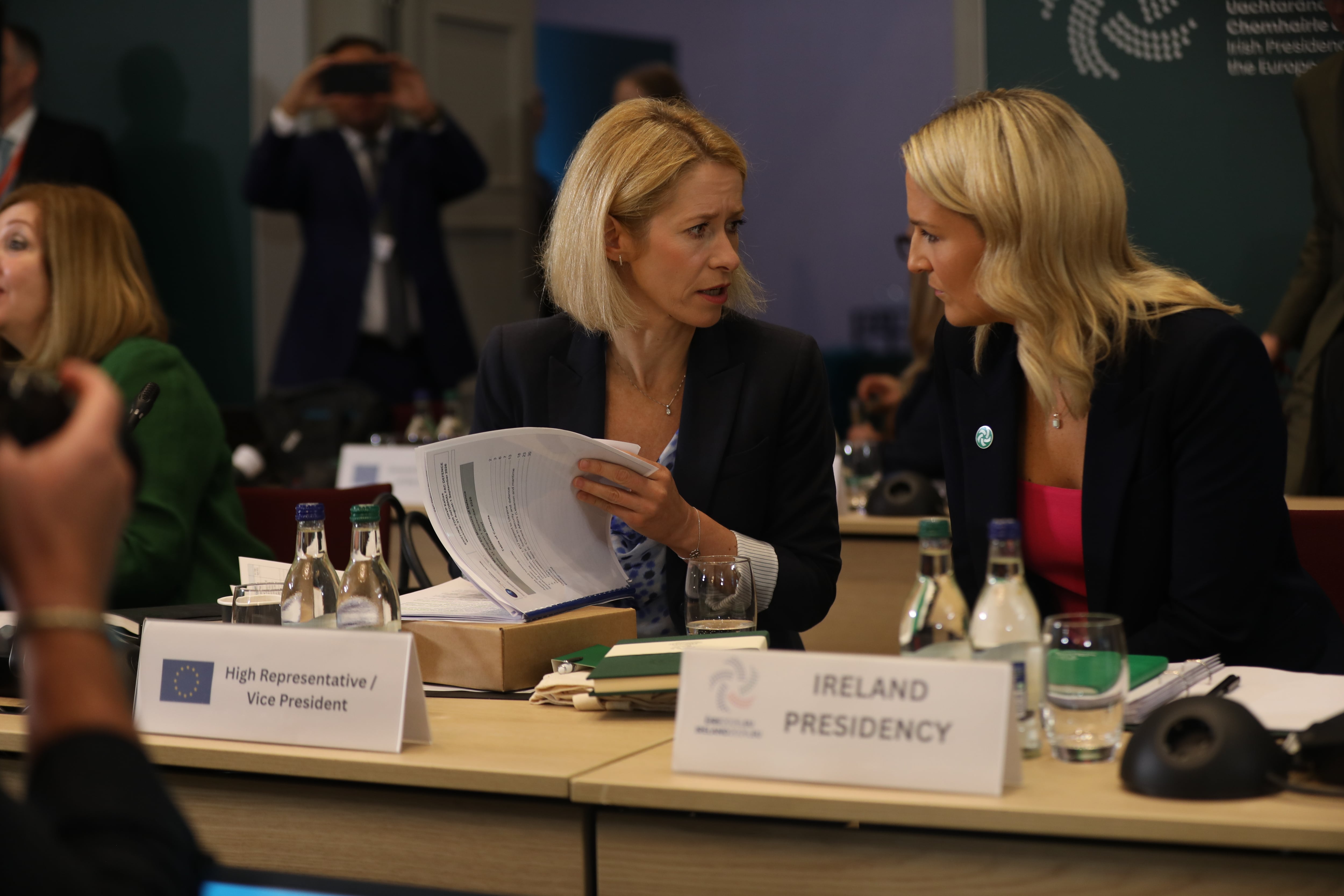
VIENNA — EU foreign policy chief Kaja Kallas scrapped plans to launch a high-level advisory group on European defense just hours before its scheduled unveiling, after several member states, reportedly including Germany, Italy and France, pushed back against the initiative.
The group, first announced by Kallas at an informal defense ministers’ meeting in Wicklow, Ireland, on Sept. 1, was meant to bring together former political and military leaders to draft recommendations for closing Europe’s capability gaps faster. Former NATO Secretary-General Anders Fogh Rasmussen was expected to chair the panel, with ex-defense ministers Jüri Luik of Estonia and Florence Parly of France among the anticipated members, according to diplomats familiar with the plans. The United Kingdom and Ukraine were also expected to take part.
The formal launch, a fireside chat with Kallas planned for Sept. 7 at Brussels’ Bibliothèque Solvay with roughly 150 invitees, was called off on the afternoon of Sept. 6, before the group’s membership had even been officially confirmed.
“Some member states felt this was not the right path to pursue at this moment,” Politico quoted an unnamed EU official as saying, adding that Kallas’s office would instead pursue “new ways of engaging with member states.”
German news agency dpa reported that Berlin’s objections were central to the reversal, and Euractiv reported that France, Germany and Italy jointly rejected the plan, which had been informally likened to a “Draghi report for defense.”
Speaking to reporters on Monday, a German defense ministry spokesperson said the government did not want to comment on consultations by EU countries, while also highlighting that Germany considers NATO the first and foremost venue for military capability planning.
“Fundamentally, defense and armaments policy are the responsibility of the member states, while capability planning and defense planning are derived from NATO planning,” the spokesperson said. Various EU initiatives such as meetings of defense ministers, PESCO, EDF, SAFE and Military Mobility are valuable “to accompany all of this,” he said.
“The EU has regularly launched various such initiatives in the past. Some find approval, some less so,” the German military spokesperson said.
The episode is the latest sign of friction between Kallas’ diplomatic service and the European Commission over who controls the bloc’s defense agenda. Some capitals are said to have worried the group would duplicate work already underway under Defense Commissioner Andrius Kubilius, while Berlin has separately pushed to fold parts of the European External Action Service into the Commission itself.
The collapse comes as Kallas has repeatedly warned that Europe cannot keep “outsourcing” its defense to the United States and must move faster to rearm as Russia escalates hybrid and, increasingly, kinetic pressure on the continent’s eastern and northern flanks.
One EU official, speaking on condition of anonymity, acknowledged the underlying problem remains unresolved regardless of the group’s fate: “Europe still needs to confront the question the group was designed to address — how to strengthen European defense faster.”
Linus Höller is Defense News' Europe correspondent and OSINT investigator. He reports on the arms deals, sanctions, and geopolitics shaping Europe and the world. He holds master’s degrees in WMD nonproliferation, terrorism studies, and international relations, and works in four languages: English, German, Russian, and Spanish.