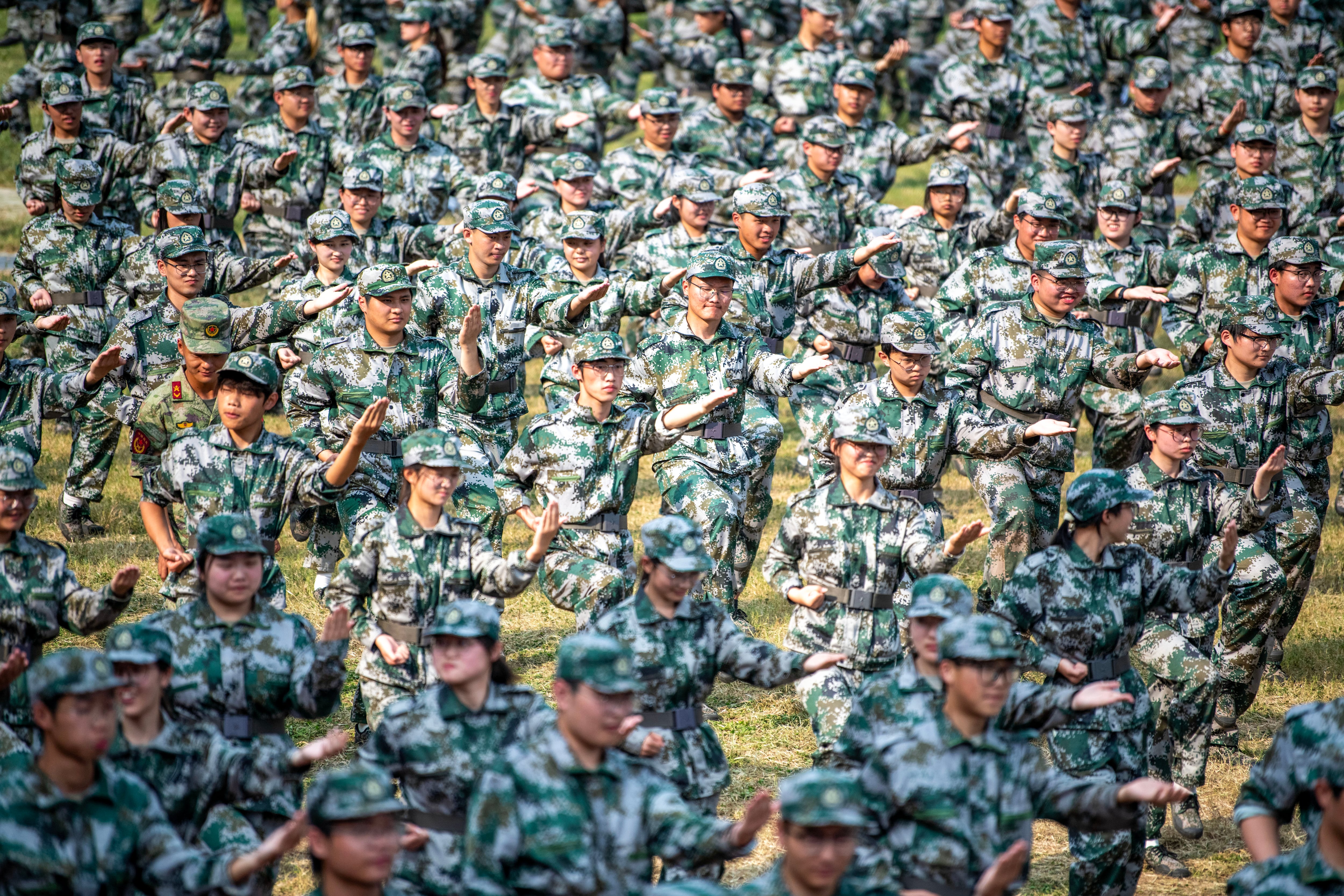
NEW TAIPEI CITY, Taiwan — China’s armed forces will get every possible resource from the home front if needed during a war, according to a change in the law to take effect in October.
And its militarily less endowed neighbors such as Taiwan and the Philippines would bear the brunt of a fully kitted People’s Liberation Army, which the updated National Defense Mobilization Law says may draw from deep within the civilian population for resources, analysts say.
Australia, Japan and the United States also would note Beijing’s revised law as they’re most likely to become involved in any Taiwan “contingency” or conflict in the South China Sea, said Carl Thayer, an Asia specialist and emeritus professor at the University of New South Wales in Australia.
Australia, India and the United States have their own issues with Beijing, he added.
“In sum, in a future conflict, China will have immediate unfettered access to relevant civilian physical and human resources,” Thayer said. “This should be a clear wake-up call to defense planners in the Pentagon and (U.S.) Pacific Command.”
The 2010 law that had not been changed over the past six years was updated to give a legal definition of “national defense mobilization,” the Chinese state-controlled Global Times news outlet said on Sept. 8.
Per that definition, the term means that when national sovereignty, national unity, territorial integrity or development interests are “threatened,” Chinese “economic and social resources” can be shifted entirely toward defense, the Global Times said.
RELATED
“This ensures that mobilization can be carried out in accordance with the law and established procedures, avoiding hasty, improvised responses in times of crisis,” it said.
China, backed by the legal revision, will be able to mobilize men and women over age 18 and take over commercial and private assets and infrastructure including planes, ships and private land, Thayer projected. He said satellite communications, cyber-security systems and drone production could go into PLA hands too.
Scholars say the legal revision, announced in late August and due to take effect on Oct. 1, may address a particular scenario, most likely in the Taiwan Strait or the South China Sea.
China sees self-ruled Taiwan as part of its territory and has stepped up military drills nearby since 2022, as Washington sells arms to the island in case of any conflict. Japan, a U.S. treaty ally, contests with China a chain of uninhabited islets.
Beijing separately disputes parts of the resource-rich South China Sea with five other governments. Beijing has expanded artificial islands and carried out military drills to bolster its maritime claims against a particularly assertive Philippines.
Japan and the Philippines, both U.S. treaty allies, are tightening security relations “to safeguard all eventualities” as they see China as a joint threat, De La Salle University international studies lecturer Don McLain Gill wrote for ThinkChina in June.
The South China Sea has kept relatively calm over the past two months, though Chinese naval presence has reached “large numbers” and grown “quite widespread”, said Jay Batongbacal, associate professor and director of the Institute for Maritime Affairs and Law of the Sea at the University of the Philippines.
“You don’t know why they do these things,” Batongbacal said of the Chinese law revision. “The timing is of course problematic and that raises concern. If it’s the South China Sea situation, they’re pretty confident they already have control over the area, so no need to mobilize.”
Taiwan and any of its supporters would feel more fear, said Denny Roy, a senior fellow at the East-West Center think tank in Hawaii.
“Taiwan, Japan and the U.S. reasonably see this as another signal that the Chinese are marching toward a war over Taiwan and thinking through the practical issues, and therefore this is another warning to stop supporting Taipei before it’s too late to avoid suffering along with Taiwan,” Roy said.
Foreign defense attaches have noted previously that China carried out a large-scale mobilization exercise in Guangdong province in 2022 as a blueprint for future mobilization.
“This could also be the result of the internal mandate to obey (Chinese President Xi Jinping’s) order to get the PLA ready for war, even if there is no decision yet to go to war.” Roy said.