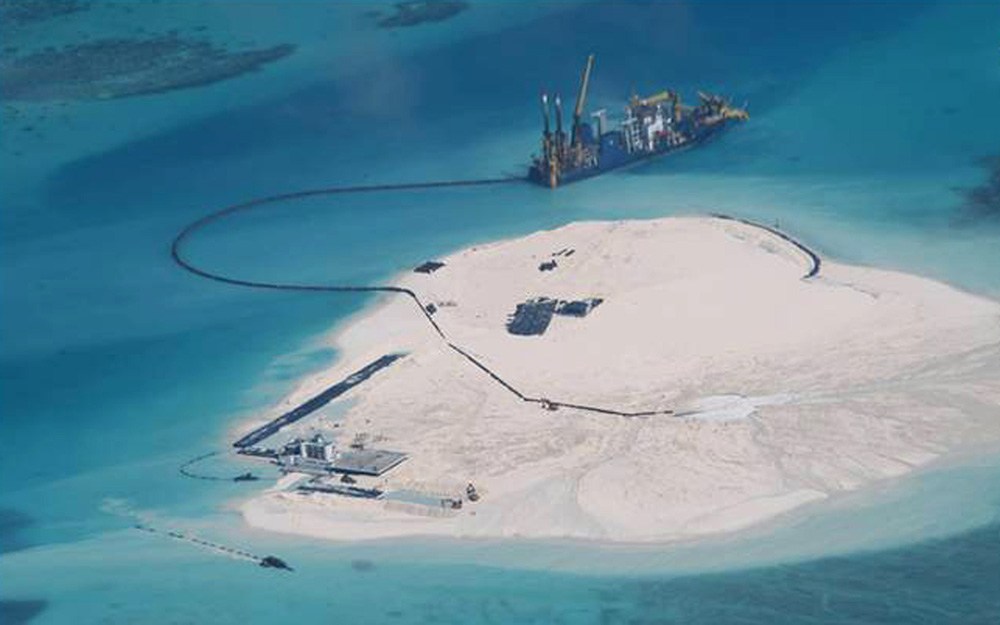
MANILA, Philippines — China has wrought widespread environmental damage in the South China Sea with its construction of artificial islands on disputed reefs, the Philippines said Monday.
The construction works have destroyed 300 acres of coral reefs, resulting in an estimated $100 million in annual economic losses to coastal states, Philippine foreign affairs spokesman Charles Jose said.
Three hundred acres is roughly three times the size of Vatican City.
“China’s massive reclamation activities are causing irreversible and widespread damage to the biodiversity and ecological balance of the South China Sea/West Philippine Sea,” Jose said.
He also accused China of tolerating environmentally harmful methods among its fishermen in Scarborough Shoal, a rich fishing ground that it has controlled since 2012, following a tense maritime standoff with the Philippines.
Satellite photos from the US-based Center for Strategic and International Studies (CSIS) released last week also showed a flotilla of Chinese vessels dredging sand onto Mischief Reef — which is claimed by Manila.
Jose said this highlighted the speed of China’s massive reclamation which threatens to dilute rival claims of smaller governments like the Philippines.
On Monday he raised alarm over his Chinese counterpart, Hua Chunying’s, comments last week saying the reclamation would serve Beijing’s military and defense needs.
“Such statements by China only serve to raise the specter of increasing militarization and threaten peace and stability in the region,” he said.
The Philippines maintains that China’s claim to almost the entire South China Sea, based on its nine-dash-line map, is illegal, he added.
“We call on China to stop the reclamation activities and to be mindful of its responsibilities as a claimant state and an important member of the international community.”
US President Barack Obama has criticized China’s use of “sheer size and muscle” to enforce its territorial claims.
The Philippines is a military ally of the United States. During a visit to Manila last year, Obama said America had an “iron-clad” commitment to defend the Philippines.
Aside from the Philippines and China, Vietnam, Malaysia, Brunei and Taiwan also have competing claims over the South China Sea, home to vital shipping lanes and believed to hold vast oil and gas reserves.
The Philippines has asked a United Nations-backed arbitration body to decide on its competing claims with China.
But Beijing has refused to participate in the proceedings, claiming it had “indisputable sovereignty” over the South China Sea.
The Philippines is also pressing the Association of Southeast Asian Nations (ASEAN) to forge a binding code of conduct with China.