LONDON — The two-year countdown to Britain's withdrawal from the European Union has been officially triggered by Prime Minister Theresa May, raising questions about the impact on the U.K. defense sector and the future for cooperation between the U.K. and the remaining 27 EU member nations at the industrial level.
The letter invoking Article 50 — the formal notification of Britain's intention to exit the organization, or Brexit — was delivered to EU President Donald Tusk on March 29, signaling the start of what will be a two-year negotiation of terms and conditions on trade and many other key issues before the U.K. officially severs its ties.
Speakers at a March 14 Royal United Services Institute conference in London on Brexit and the defense industry acknowledged it was pretty much a step into the unknown for the sector and it could be a while before the fog clears.
"Defense is not a central issue because the negotiations the prime minister is about to trigger, in large part because our cooperation with our EU neighbors on defense has an institution, NATO, which will remain in place. ... That means that the direct implications on defense are perhaps less than they would be if the EU were that forum," RUSI Deputy Director-General Malcolm Chalmers told the conference.
Analysis house Rand Europe, however, pointed out in a post-Brexit defense and security report published earlier this month that defense equipment suppliers could get caught up in wider British economic and budgetary issues even though suppliers here do relatively little business with the rest of Europe.
"Brexit presents challenges for the UK's already ambitious defence equipment spending plans, especially given the fall in the value of sterling ... the British military could struggle to implement its procurement plans if defence is not exempted from possible government spending cuts if the economy falters," Rand warned.
Overall, U.K. defense firms are "less vulnerable compared to other sectors to major losses in the event of a 'hard Brexit', given EU sales account for only four per cent of [UK defense] turnover," the report read.
U.K. government figures show just 8 percent of Britain's £7.7 billion (U.S. $9.7 billion) defense export sales for 2015 went to Europe, although the country does better selling security equipment in the region.
One big area of concern for the British defense industry following Brexit is research and development, said Rand.
"The UK risks reduced access to EU funds for research, and influence over the research agenda. The EU is planning to invest hundreds of millions of euros in new defense [research and development]," according to the report.
The poor showing of U.K. defense sales into Europe partly reflects the fact that EU attempts at an open market for defense procurement in the region have largely failed, with governments more often than not choosing to protect local jobs and technology by invoking national security grounds to avoid open competition.
Sophia Besch , a researcher at the Centre for European Reform, told the RUSI audience that "on balance Brexit could mean that in the EU countries that are proponents of European protectionism, of the buy Euro mentality, will have a greater voice post Brexit."
Notwithstanding the economic and exchange rate pressures potentially influencing defense procurement, Besch said that whatever the outcome of the negotiations, the impact on industry may not be felt for a while, in part due to the duration of existing equipment programs.
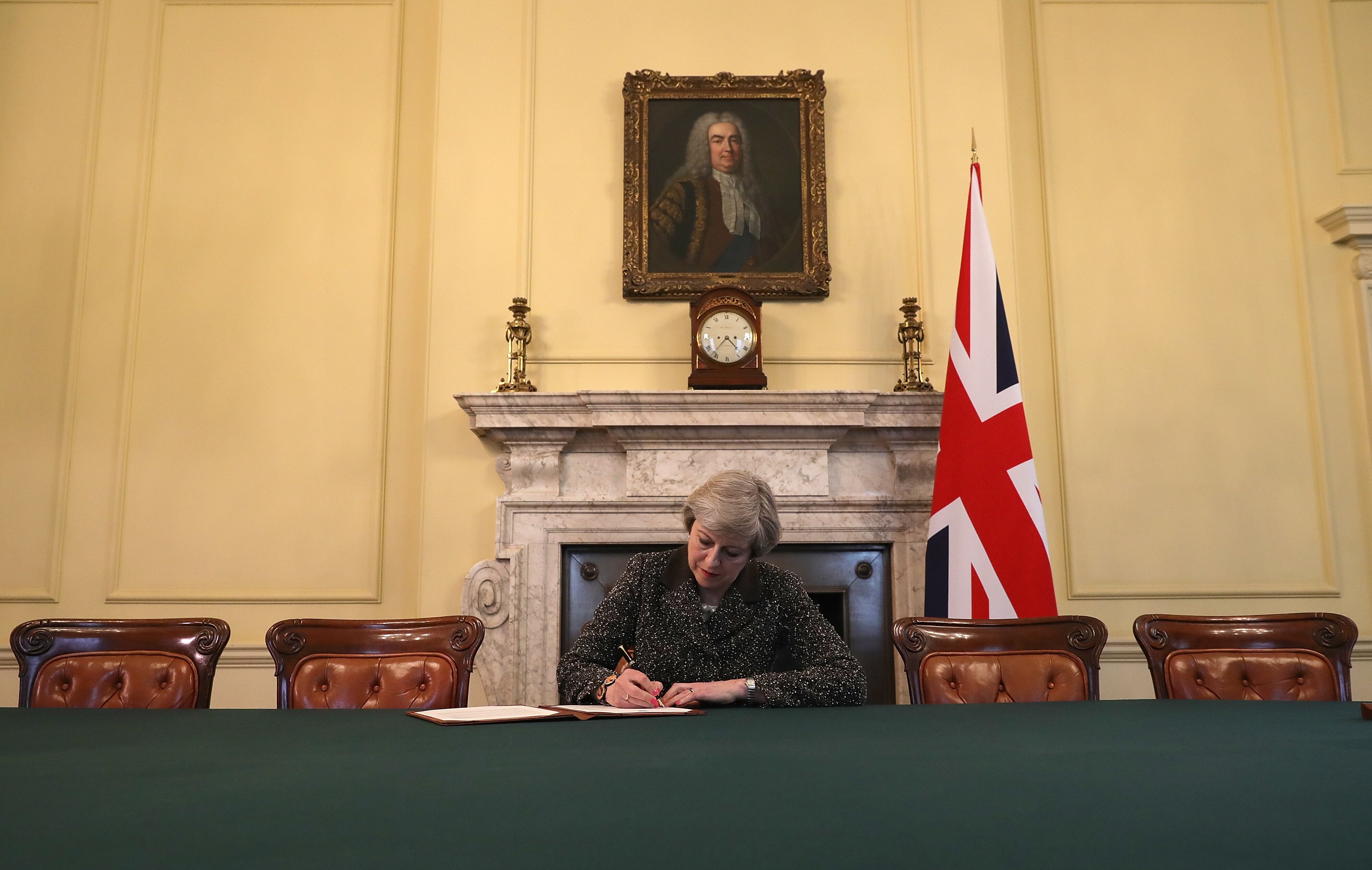
British Prime Minister Theresa May on March 28, 2017, signs the official letter in London, England, to European Council President Donald Tusk invoking Article 50 and the U.K.'s intention to leave the European Union.
Photo Credit: Christopher Furlong/Getty Images
"Ongoing projects run over a long time span and are unlikely to be gravely affected by Brexit the day the U.K. leaves the EU. So in the short term, no real drastic changes; but in the long term, one big question is: Could the U.K. be left out of major procurement programs in the future?" Besch offered the conference attendees.
Nick Witney, a senior policy fellow at the European Council on Foreign Relations, reckons the U.K. may find itself an outsider when Europe comes to stitching together future joint equipment programs.
"There will be opportunities for the British to associate project by project if they want to, very much in the spirit of the man who sits outside the door and every now and again its opened by someone who comes out and says: 'The rest of us have decided we are going to do this, do you fancy chipping in?' Better than nothing, but actually not anywhere near the driving seat," Witney, a former chief executive of the EU's European Defence Agency, told the conference.
'Significant challenges in the coming two years'
How cooperation will play out is, like so much else about Britain's withdrawal, unclear.
There is little we know about the negotiating positions of London or Brussels at the moment, although May's letter confirmed the British will leave the single European market arrangement and instead seek to negotiate a trade deal, a position known in Britain as a hard Brexit.
Failure of the two sides to agree to a free trade arrangement could disrupt defense supply chains into and out of the U.K., although the impact is likely to be limited compared with other sectors of the economy.
Paul Everitt, the CEO of the defense, aerospace and security trade lobby group ADS, said "failure to agree a new trade relationship would undermine competitiveness and threaten the many high-value, long-term jobs our companies sustain in the U.K. and across the European Union."
"There will be significant challenges in the coming two years and it will be important for government and industry to work closely to inform and secure the successful outcome we all desire," Everitt said.
Although the British will exit the EU in 2019, the complexity of the divorce proceedings could mean that only the broad outline of a deal is in place by then, requiring more detailed negotiations on issues like trade that could continue for several years.
To an extent, the prospects for continued defense collaboration may depend on how acrimonious the exit negotiations become and what kind of arrangement can be struck to keep the U.K. aligned with the wider European defense architecture — mainly through NATO, but also through Europe's common defense and security policy framework.
Besch said it was important to recognize that the EU currently has little influence or input on the Europe continent when it comes to putting major defense equipment program cooperation in place.
Joint program development is intergovernmental, using frameworks like the letter of intent cooperation agreement signed by Britain, France, Germany, Italy, Spain and Sweden, rather supranational, with EU input, she said.
How that might change over time remains to be seen, but EU interest in defense is growing.
The organization is talking about bankrolling a significant investment in defense research and development, while with the British heading for the door there are now moves afoot to create an EU military headquarters — although there is considerable skepticism whether the latter will make any difference to most of its members' military ineffectiveness.
According to Rand, Brexit "could prove a catalyst for more ambitious EU defence integration, freed from the UK's veto. However, losing the UK entails a considerable diminution of collective EU defence capability, which some estimate will be reduced by a quarter. "
Large multinational European programs are pretty much out of vogue at the minute. But Britain currently cooperates with its European partners on a number of big-ticket programs, including procurement of Typhoon jets, A400M airlifters and Meteor air-to-air missiles.
Instead of multinational programs, the British have more recently focused on bilateral arrangements, predominantly with France, which has led to several joint missile programs and work on unmanned underwater mine clearance systems. And perhaps most notably the two sides are in the early stages of cooperating on the development of an unmanned combat air vehicle, or UCAV.
As though to emphasize that it's business as usual, at least on the bilateral front, the British and French governments on March 28 announced a joint €100 million (U.S. $109 million) deal for MBDA to undertake a three-year concept phase on a cruise/anti-ship missile to replace weapons like Storm Shadow, Scalp and Harpoon.
There is also talk of a possible closer bilateral arrangement with Germany, mainly at the military level but also possibly at the industrial level in terms of armored vehicle and other programs.
Interestingly, Tom McKane, a former senior British Ministry of Defence policy adviser and now a senior associate fellow at RUSI, thought the Anglo-French UCAV requirement might find itself at the center of a debate in the U.K. over whether London should throw in its hand with the U.S. on the requirement or stick with the European option.
"One project I would be keeping an eye on is the Anglo-French cooperation on the UCAV. It is one of the only big aerospace projects [in Europe] in the sense it would help the two nations' fixed-wing military aviation industries survive, and one can see all the arguments being played out [in the U.K. government] over a European option versus a U.S. option," he told conference delegates.
McKane believes that from where Britain buys its weapons could be an issue down the road. "A perennial debate goes on in the MoD about whether to source equipment from the U.S. or Europe. I guess [Brexit] will strengthen the arm of those wanting to opt for the transatlantic option. That is something worth watching. If the other European allies want to prevent that outcome, is there anything they can provide by way of an incentive?"
However, Witney is of the belief that there is little future for British industry in U.S. cooperation.
"Although British generals and admirals are very comfortable with the idea of the transatlantic future, U.K. defense industrialists know, like it or not, there is no future in industrial or research cooperation across the Atlantic," the former European Defence Agency boss said.
"There never has been a future because of U.S. determination to deny market access to European firms and because of the rooted objection to the U.S. to sharing technology. I say this not accusatorily — if I spent all the money and had all the technology I wouldn't be handing it out to others either. But this does actually make any realistic form of technological or industrial cooperation in defense in a balanced form unfeasible, which is why we already have a fairly well-integrated defense industry in Europe," he added.
Notifying Brussels of Britain's intention to exit the EU comes just 24 hours after the devolved Scottish Parliament voted in favor of the government in Edinburgh requesting a second independence referendum.
Industry analysts here say Scottish independence would be more disruptive to the British defense sector than Brexit.
The U.K. government has already said it will not approve any referendum attempt until after the Brexit negotiations come to a close.
Andrew Chuter is the United Kingdom correspondent for Defense News.