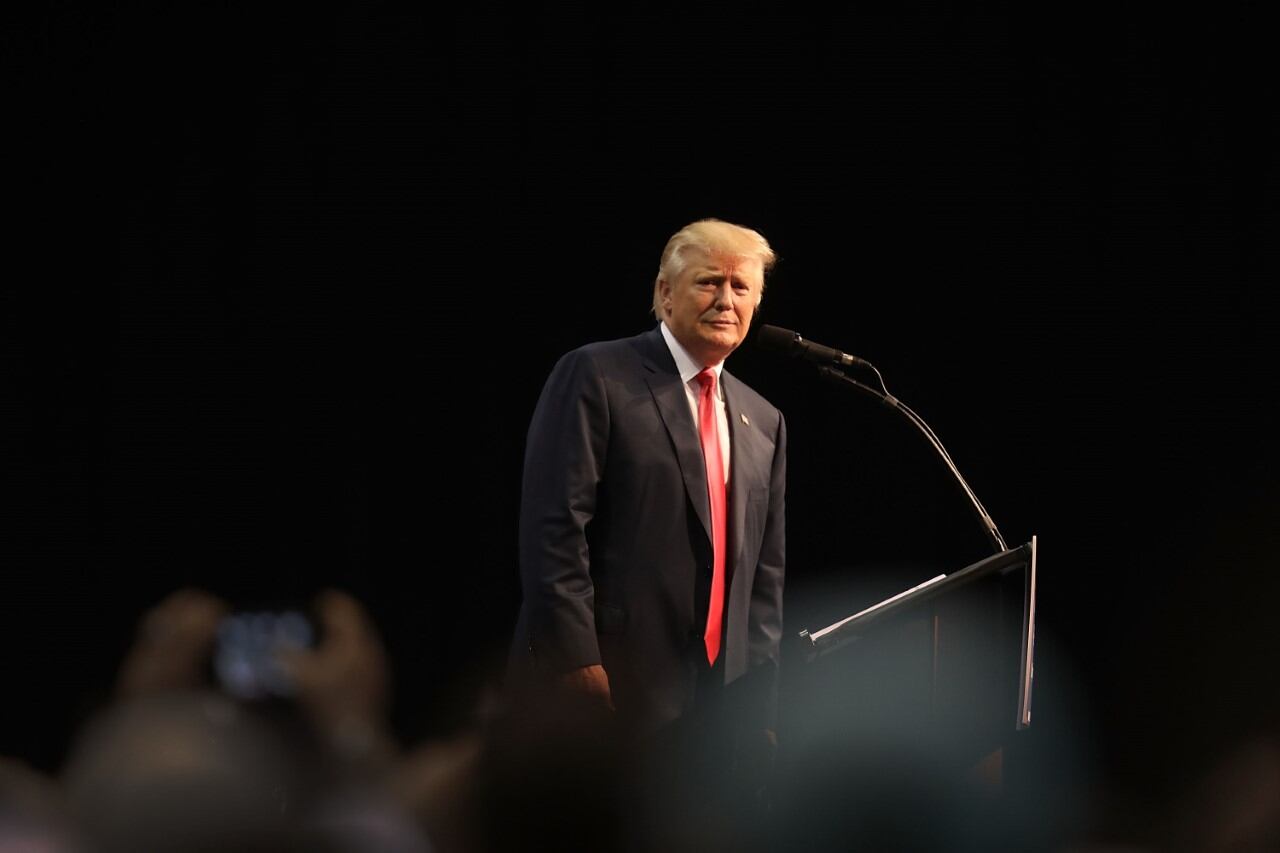
WASHINGTON — When Donald Trump delivered a speech on his plans to defeat the Islamic State on Monday, he declared an end to nation building and promised to lead the US in an ideological battle against radical Islam akin to the Cold War.
But the grandiose aims aside, exactly who would implement them in a Trump administration remains an open question. Some in the national-security and foreign-policy communities openly wondered ahead of the speech who would work for real-estate mogul, given the polarizing ideas at stake.
President Obama, Democratic contender Hillary Clinton and other Democrats have said Trump is alienating allies with his temperament and proposals. The same applies to much of the intelligentsia in Trump's own party. Fifty national security officials from GOP administrations, in a letter made public last week, said Trump would be a "dangerous" president and "lacks the character, values, and experience" for the job.
Asked Christopher Preble, of the libertarian-leaning Cato Institute, in a recent blog post: "If these men and women are true to their word, and refuse to support the GOP standard bearer, it begs a larger question: If Trump wins in spite of this elite opposition, who exactly would staff the many defense and foreign policy positions in a possible Trump administration? It is a question I've been asking myself for months."
Both Trump and Clinton face a challenging transition into power. It's a 73-day sprint from the election to Inauguration Day Jan. 20, but analysts say Trump's bare-bones campaign lacks the deep bench of advisors who typically migrate into staff positions once a candidate takes office. The next president will have 4,000 positions to fill, with roughly 400 appointments at the State Department and more than 200 with the Defense Department.
The nonpartisan Center for Presidential Transition, which helps campaigns get ready to take power, is urging the two camps to get as much of their teams in place as possible. "Your top leadership team is in place, and now is the time to start sourcing your talent, thinking about presidential appointments," said the center's director, David Eagles.
While it's unusual this early for a presidential candidate to name prospective cabinet officials, like a defense secretary or secretary of state, pundits have suggested Trump could do so to reassure the GOP establishment and give his sagging poll numbers a boost. In an Aug. 11 interview with radio host Hugh Hewitt, Trump said that's not his plan.
"Once you name that somebody, they attack that person viciously," Trump said. "Whereas if you don't, and you win, and then you put the same person in, nobody cares. If you pick a good name—and there are plenty of them, you put them into a position, everybody's happy—that person for the next 90 days gets attacked viciously. That's why people haven't traditionally done that."
Asked if he would consider John Bolton, a US ambassador to the United Nations under President George W. Bush, for secretary of state and former Missouri Sen. Jim Talent for defense secretary, Trump called Bolton "a good man" and said, "We are seriously thinking about it."
Assembling a Team
Typically, on Inauguration Day, after the ceremony and before a luncheon, the president walks to the President's Room, which is off the Senate floor, to sign nomination papers for cabinet officials, which then go to the relevant confirmation committees.
Who will the nominees be? For now, the adage applies that those who talk don't know and those who know don't talk, said Arnold Punaro, a retired Marine Corps general, veteran congressional staffer and Defense Business Board member.
At this stage, both camps should be considering national-security teams of 10 core people to work with the defense secretary, including general counsels, undersecretaries, and service secretaries. The team should mix significant experience in policy, business, management and science—with a Pentagon insider at the top.
"A key consideration is if you look at some of our most successful secretaries of defense, they've come up through the system," Punaro said. "They've had previous jobs in the Department of Defense. You really want to draw on people for the Department of Defense who have a proven track record in government. You cannot just bring somebody who has been a very successful businessman or -woman at a profitable company and think they can just come in and run the Department of Defense."
While Clinton has an insider's Washington network to draw on, Trump's outsider campaign has flummoxed some Pentagon watchers.
"On the Trump side, it's not clear to me that he's yet garnered an understanding of what it would take to run the Department of Defense, so I really have no way of speculating as to what their approach might be," Punaro said.
A Non-Traditional Campaign
Below the cabinet-secretary level, there are a bevy of deputies and undersecretaries who are typically drawn from the ranks of the campaign's policy advisors—traditionally. Yet Trump's lean campaign is "very non-traditional" and this far has reached out to few potential foreign-policy advisors, said Jim Carafano, of the right-leaning Heritage Foundation.
"There is this kind of big white space that hasn't been filled yet of senior policy advisors who are lining up around big portfolios," Carafano said. "I just don't see that yet."
Still, Carafano downplayed the advisor pool as unnecessary at this stage, calling such people "just a name on a list somewhere" and "for show." The campaign in the next 90 days, he predicted, will do the serious work of fleshing out its team.
The Trump camp does include a small constellation of policy advisors. Among them are Newt Gingrich and New Jersey Gov. Chris Christie, who chairs Trump's transition team. There are also staffers like J.D. Gordon, a Trump campaign official and a former spokesman at the Pentagon; policy director John Mashburn, a former chief of staff to Sen. Thom Tillis (R-N.C.); and senior policy adviser Stephen Miller, a longtime aide to Trump ally Sen. Jeff Sessions, R-Ala.
"In a normal presidential team, there is a certain amount of [political] payback, and Trump doesn't have that baggage," Carafano said. "He can pick whoever the hell he wants. It's an advantage, because you really have to pick a team."
By painting his policies with broad brush strokes, Carafano said, Trump is leaving more room for himself and policy experts to maneuver and collaborate after the people are tapped.
"If your vision is a strong military and bring down the temperature in different parts of the world, you can bring in different people who share your vision, though they may have a different way to get you there," Carafano said.
A Great Negotiator
While Trump has been accused of offering conflicting or vague thoughts on foreign policy, there is a steady through-line, according to Alex Ward, a national security expert with the Atlantic Council, who has studied the candidate’s public comments.
Unconvinced that the post-World War II world order benefits the United States, Trump appears to want to either return to an earlier era or establish a new world order, unilaterally, while disengaging from world affairs, Ward said. Centrally, the US is giving too much to these alliances and not getting enough back, the argument goes.
Trump has cast himself as a great negotiator who will personally redeem the US from bad deals with allies and will resolve conflicts that have heretofore been intractable. For instance, Trump told the New York Times in June that he could resolve the Turkish-Kurdish conflict through "meetings."
"Only he can remove the US from its current structures and actually change them so that, while we might be less engaged, everything benefits the US on a global scale," Ward said. "To me, that’s not an isolationist standpoint, it’s very activist, pro-American foreign policy, where everything is good for us. He wants all of the foreign-policy benefits without any of the foreign-policy work—except that he alone has the deal-making ability to pull all this off."
Trump has said he wants to "rebuild" the military but not necessarily use it beyond fighting the Islamic State. Speaking on the deck of the decommissioned USS Iowa in September, he said: "We’re going to make our military so big, so strong and so great, so powerful that we’re never going to have to use it."
Who would make him a suitable partner as defense secretary or secretary of state? Noting Trump did not select his running mate, Indiana Gov. Mike Pence, based on loyalty, but politics, Ward speculated he could yet draw his cabinet from his most prominent supporters: Sessions, who sits on the Senate Armed Services Committee; House Armed Services Committee Member and former Marine Duncan Hunter, R-Calif.; or retired Lt. Gen. Michael Flynn, the former chief of the Defense Intelligence Agency.
Though Flynn’s military experience and ideological slant—both he and Trump favor cooperating with Russia in defeating ISIS—make Flynn the best fit as defense secretary, Ward speculated that Flynn’s background suggests he is more interested in the job of Central Intelligence Agency director.
Ward contends that policy details may not matter to the Trump camp, at least at this stage. As the New York Times reported last month, when Trump’s son Donald Jr. asked Pence to be his father’s running mate, he said the vice president would be in charge of both domestic and foreign policy.
"It’s ‘We’re going to defeat ISIS and remove America from its alliances,’ and everybody in his inner circle kind of agrees with it in principle," Ward said. "The varying degrees, I don’t think matter to Trump; I think he will have his people at State and elsewhere just run his foreign policy."
Although there is an unusual amount of political involvement from recently retired uniformed officials, that does not mean they are in line for positions in government. According to Punaro, it is safe to dismiss such speculation because of a statute, which he recommended as a congressional staffer, that bans such officials from serving again for seven years. The idea is to protect civilian control of the military.
"You want competent, experienced civilians at the top," Punaro said. "So it’s really important who you put in. That’s the reason for that ban, and it is not waiver-able."
Troubled Think Tankers
Fueling concerns about him, Trump has complimented Russian President Vladimir Putin, invited Russia to hack Clinton’s email server—remarks he later said were meant to be sarcastic—and said he would decide whether to defend NATO members from a Russian attack based on whether they contributed to the alliance. He has also suggested he would support pulling US troops out of Japan unless Tokyo picked up more of the tab for hosting US bases.
The 50 former senior officials who rebuked Trump said his "character, values, and experience" make him a liability. "Unlike previous Presidents who had limited experience in foreign affairs, Mr. Trump has shown no interest in educating himself," their letter said.
Preble, of the Cato Institute, told Defense News that his colleagues have been distressed by Trump’s scorn for Senate Armed Services Chairman John McCain’s Vietnam War heroism, Trump’s openness to using torture and his vow to "go after" terrorists’ families—an idea Preble called "clearly a war crime" and "deeply worrisome to me."
On Monday, Trump called for "extreme vetting" for US visa applicants, which would include an "ideological screening test" to eliminate those who espouse "bigotry and hatred." In December, Trump called for a moratorium on Muslim immigration.
"I’m troubled by that, as are others in this field," Preble said of the moratorium. "The idea of a religious test is an anathema. It’s foundational to US practice for the last 100 years or so."
Likely Candidates
Foreign policy and national security expert Michael O’Hanlon, of the Brookings Institution, said there remains a very large pool of talented people in the national-security and foreign-policy communities. Some are bound to join a Trump administration out of ambition or a duty of serving the country by offering good advice—even if they disagree with him.
While O’Hanlon is no fan of Trump, he said the rebuke by 50 experts "in no way incapacitates him."
The signatories did not include several high-profile former officials such as Bush national security adviser Stephen Hadley or Richard Haass, a former advisor to Secretary of State Colin Powell and now the president of the Council On Foreign Relations. It was unknown if they were invited to sign.
Hadley earlier this month said Republicans who endorse Clinton over Trump risk losing a voice in the future of the GOP.
"If Donald Trump somehow won, I would prefer Steve Hadley be his secretary of state rather than see the Steve Hadleys of the world decline out of principle or disgust," O’Hanlon said. At the same time, O’Hanlon said he would prefer potential candidates to say outright that Trump is not a good choice before the election.
Others have speculated that Zalmay Khalilzad, an ambassador to Afghanistan, Iraq and the United Nations under President George W. Bush, may be in line for a position. Khalilzad, who introduced Trump before a foreign-policy speech in Washington in April, did not rule out serving in a Trump administration in a recent CNN interview.
"I am an American. I want to help my country, the United States," Khalilzad said. "I think that a leader that is willing to unify America, not to divide America, and is willing to follow an intelligent, long-term strategy, that has elements of offense and defense against those who wish us ill — but also positive engagement – I would be more than happy to offer my views and advice to any of our leaders."
Trump might deftly retain his outsider status while signaling a more deliberative, less disruptive approach to implementing his foreign policy by reaching outside the beltway, O’Hanlon said. There, there are academics who, contrary to the bipartisan consensus, are skeptical of the US intervention in global affairs.
"There is a longstanding tendency going back to Vietnam that the US has to be assertive and engaged, and there is a counterculture to that concept and a community in academic circles," O’Hanlon said. "There are a number of people Trump could have affiliated with out of that debate."
O’Hanlon pointed to Barry Posen, director of the security studies program at the Massachusetts Institute of Technology, who favors the US pull back from its alliances. Posen authored, among other books, "Restraint: A New Foundation for US Grand Strategy."
"If he showed enough interest in the debate by choosing people who are policy-focused but not the same old crowd, he could be a more serious candidate with the same kinds of principles he’s running on, but with less of a cavalier, reckless approach," O’Hanlon said. "He seems more content to shoot from the hip."
Aaron Mehta in Washington, D.C., contributed to this report.
Email: jgould@defensenews.comTwitter:
Joe Gould was the senior Pentagon reporter for Defense News, covering the intersection of national security policy, politics and the defense industry. He had previously served as Congress reporter.