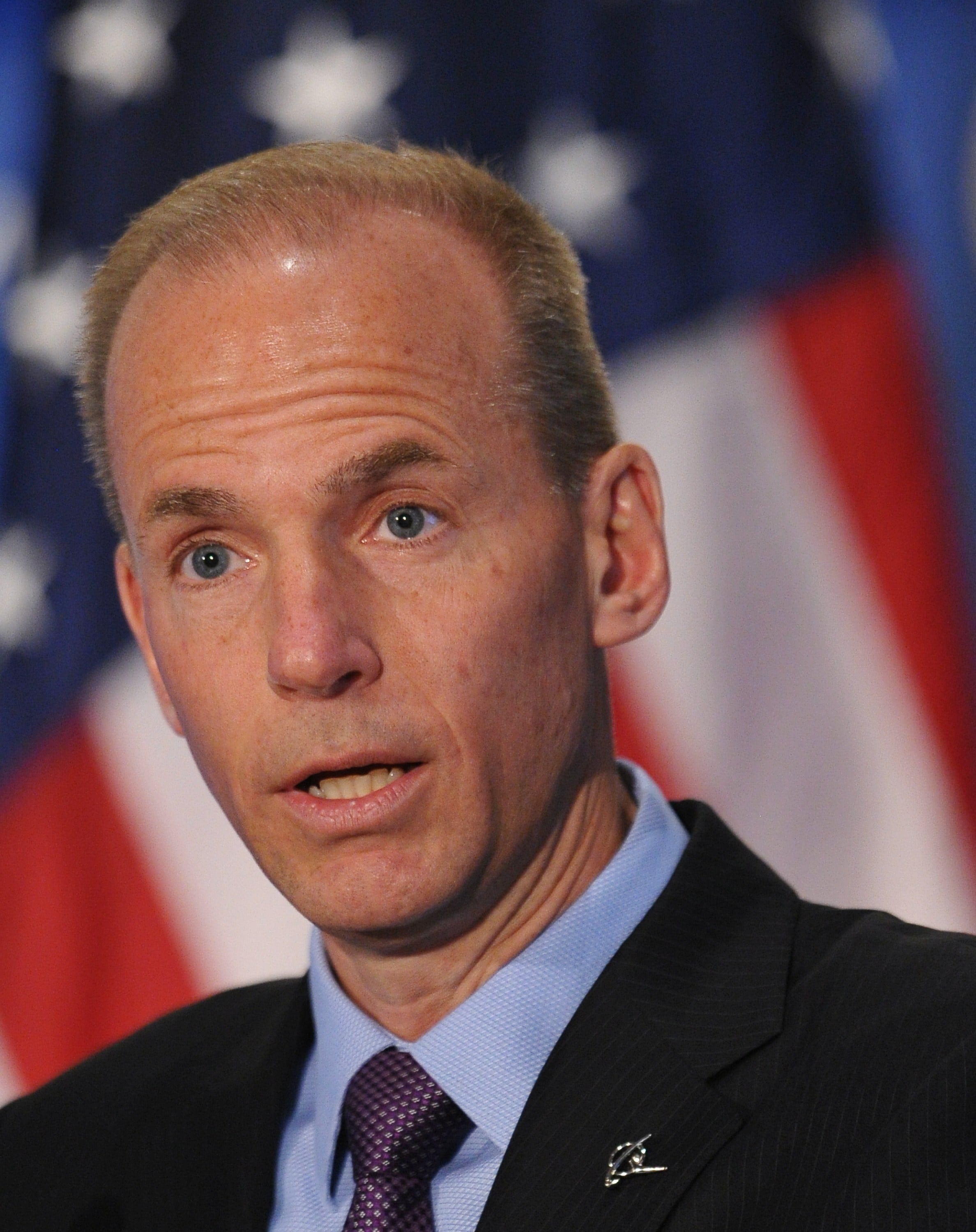
WASHINGTON — Dennis Muilenburg's promotion to CEO of Boeing represents a smooth transition for the American airplane maker, and likely indicates Boeing has no intention of leaving the defense sector even as some of its signature platforms are winding down.
Muilenburg has been the heir apparent to outgoing CEO W. James McNerney since being named Boeing president and COO in 2013. The company announced last week that McNerney will remain chairman of the board when Muilenburg becomes CEO effective July 1.
"Initially, we expect the Boeing mantra to be 'continuity,' and in practical terms that fairly reflects the businesses that the company is in. Over time (especially when McNerney eventually steps down as chairman), we'd expect Dennis to be tackling some of the tougher issues — for example the 777 rate, a 757 replacement, perhaps some portfolio actions in defense," wrote Robert Stallard of RBC Capital Markets in an analyst's note.
As an engineer who rose through the ranks of Boeing's defense business, Muilenburg is the kind of CEO who has been successful at the helm of major defense contractors, said Anita Antenucci, senior managing director at Houlihan Lokey. His promotion shows that Boeing is thinking expansively about its defense business, not just about selling another bomber or helicopter, she said.
Muilenburg's ascension to the CEO position sends the message, "Don't doubt that we will remain committed to our defense business," she said.
Richard Aboulafia, the Teal Group's vice president of analysis, said Muilenburg will face some tough decisions, especially if Boeing doesn't win the competition for the US Air Force's Long Range Strike Bomber (LRS-B). The competition for the LRS-B contract has come down to two bids, one by Northrop Grumman, and the other a team of Boeing and Lockheed Martin. A decision on the program is expected in August or September.
While company officials recently said Boeing has enough F/A-18 Super Hornet sales to keep the line running through 2019, the company likely needs another major platform to continue as an attack aircraft manufacturer, Aboulafia said.
"You lose a program like LRS-B, you have to make big decisions at the corporate level," Aboulafia said. Even winning the competition for the T-X, the US Air Force's next generation trainer program, would not necessarily be enough for Boeing to remain competitive in the sector, he said.
"It's either gradually exit military airframes, or alternately, buy Northrop's aerospace unit," he said.
Aboulafia agreed that Muilenburg's promotion represents continuity in leadership for Boeing.
"He's always been the most stable and well-received and well-liked option," he said. "He does have a very strong reputation and strong background."
Cai von Rumohr, an analyst with Cowen and Co., said Muilenburg's elevation represents an orderly management transition, especially with McNerney staying on as chairman until 2016, when Boeing will celebrate its centennial.
"Given [that] Muilenburg has been groomed for the top slot for some time, we expect few changes in [Boeing's] direction which has focused on (1) reusing R&D to mitigate risk, (2) improving manufacturability of commercial aircraft, (3) stabilizing BA's military business with emphasis on cost cuts, and (4) generating cash for shareholders," von Rumohr wrote in a note to investors.
Muilenburg, 51, has previously served as president and CEO of Boeing Defense Space & Security and as president of the unit's Global Services & Support business. He also led Boeing's Combat Systems division. He joined the company in 1985 as an intern.
Email: aclevenger@defensenews.com
Twitter: @andclev