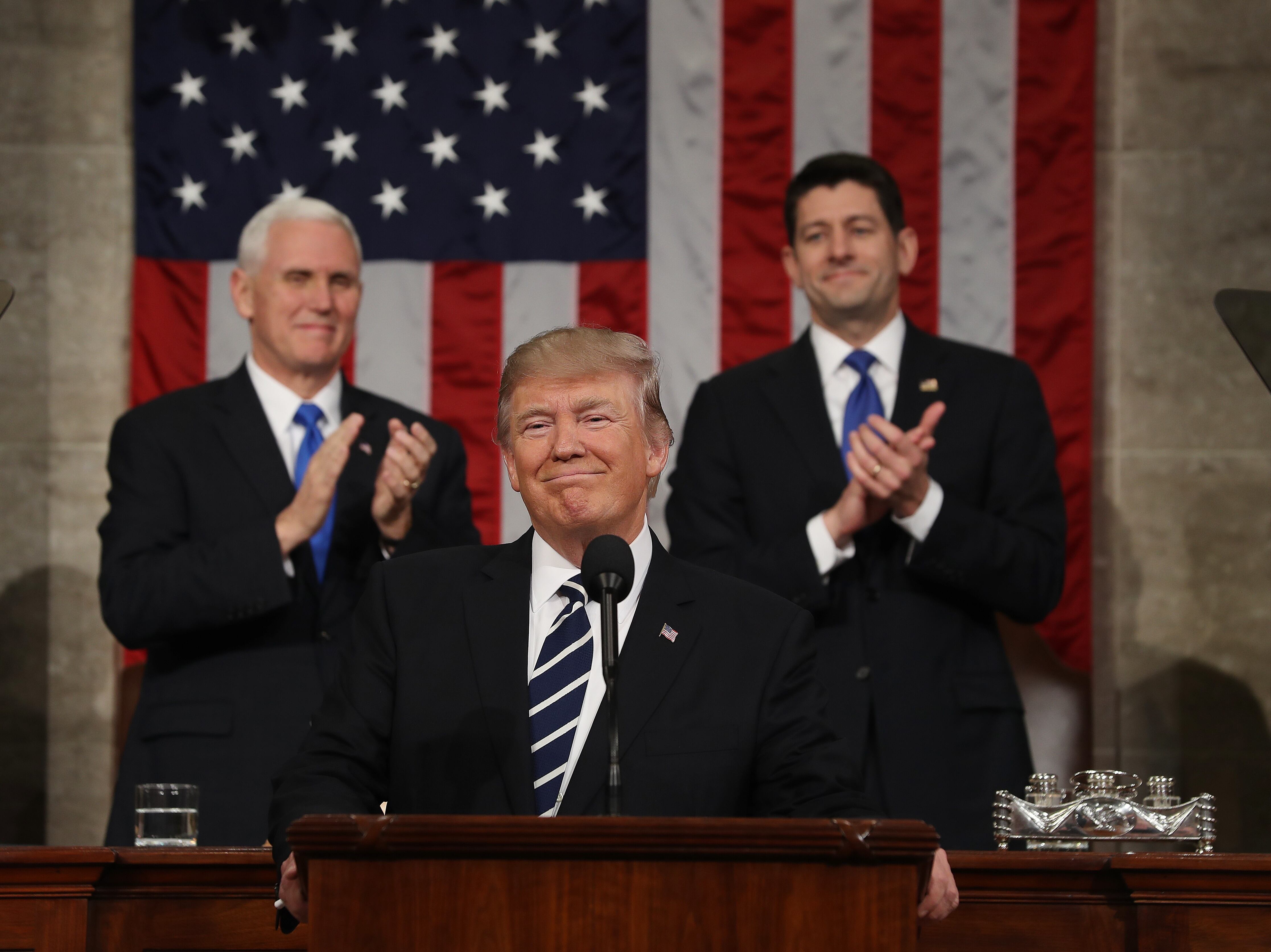
WASHINGTON — President Trump, in his first joint address to Congress, pledged strong support for NATO, but called for allies around the globe to "pay their fair share of the cost."
Trump's speech carried familiar "America First," pro-industry, anti-regulation and tax reform messages. He also reiterated his pledges to rebuild the U.S. military and combat "radical Islamic terrorism," while exaggerating his role in bringing down the price of the F-35 jet fighter.
"We strongly support NATO, an alliance forged through the bonds of two World Wars that dethroned fascism, and a Cold War that defeated communism," Trump said to a standing ovation that included many Democrats.
"But our partners must meet their financial obligations. And now, based on our very strong and frank discussions, they are beginning to do just that — and in fact, I can tell you the money is pouring in," he said to more muted reaction.
"We expect our partners, whether in NATO, in the Middle East, or the Pacific — to take a direct and meaningful role in both strategic and military operations, and pay their fair share of the cost — have to do that," he said.
Trump also signaled a restrained U.S. foreign policy, saying it would, "respect historic institutions, but we will also respect the sovereign rights of nations."
"Free nations are the best vehicle for expressing the will of the people — and America respects the right of all nations to chart their own path," Trump said. "My job is not to represent the world. My job is to represent the United States of America. But we know that America is better off, when there is less conflict — not more.
The remarks came two weeks after Defense Secretary James Mattis said at the Munich Security Conference that Trump had thrown his "full support" behind the alliance. Mattis and Vice President Mike Pence also said the administration expects allies to accelerate plans to share more of the burden.
Allies have said publicly that they will go along. NATO Secretary General Jens Stoltenberg recently said he too expects allies to ensure fairer burden sharing, and noted that defense spending among European allies and Canada rose 3.8 percent over 2016. Ursula von der Leyen, the defense minister of Germany said it was a "fair demand" that it pay more.
As a candidate, Trump sparked controversy when he suggested that the U.S. might not aid an ally that did not pull its weight under his leadership. However, U.S. concerns over spending levels by NATO allies is not new, as the U.S. pays 72 percent of the alliance's total military expenditures, and only four counties meet the 2 percent target.
Trump has been accused of using rhetoric that undermines NATO's cohesion. Massachusetts Democratic Sen. Ed Markey, a member of the Senate Foreign Relations Committee, said Trump is emboldening Russian President Vladimir Putin.
"The one ambition that Vladimir Putin would have is to break this relationship apart," Markey told CNN on Feb. 22. "That would be key to him, once again from his perspective, being able to reassert a Russian role that is significant on our planet and the only way to counter it is to keep the E.U. and the United States together on the same page."
The president also trumpeted his budget blueprint, announced earlier this week. For 2018, the White House is offering a $603 billion top line for the base defense budget and a $462 billion top line for the non-defense budget — a combination that has been criticized by hawkish Republicans as too little for defense and by Democrats who balk at the steep domestic cuts.
"Finally, to keep America safe we must provide the men and women of the United States military with the tools they need to prevent war and — if they must — to fight and to win," Trump said. "I am sending the Congress a budget that rebuilds the military, eliminates the defense sequester, and calls for one of the largest increases in national defense spending in American history."
Otherwise, to combat the Islamic State, Trump said he would "work with our allies, including our friends and allies in the Muslim world, to extinguish this vile enemy from our planet."
"As promised, I directed the Department of Defense to develop a plan to demolish and destroy ISIS — a network of lawless savages that have slaughtered Muslims and Christians, and men, women, and children of all faiths and beliefs."
Joe Gould was the senior Pentagon reporter for Defense News, covering the intersection of national security policy, politics and the defense industry. He had previously served as Congress reporter.