ORLANDO, Fla. – The head of the F-35 joint program office (JPO) wants to inject more competition into the training and simulation side of the program.
"We're looking at increasing the competitiveness across our entire enterprise to improve our training enterprise," Lt. Gen. Christopher Bogdan told an audience at the I/ITSEC conference here.
Lockheed Martin, the primary contractor on the program, controls the vast majority of the training and simulation contracts. Without naming them, Bogdan sent a clear message that control may be coming to an end in the future.
"It is not a forgone conclusion that today's F-35 industry partners have earned the right to be the long-term supplier for training and simulation products on this program," he warned. "It is not a given."
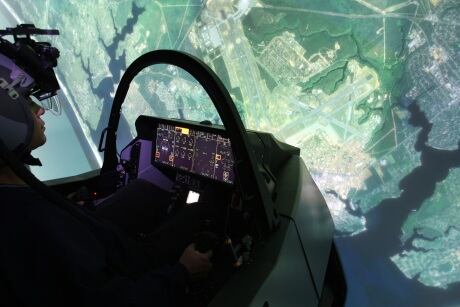
In an exclusive interview with Defense News following his speech, Bogdan held up the Lockheed-produced Deployable Mission Rehearsal Trainer (DMRT), a portable trainer setup for the jet, as an example of one program that he wants to see opened up.
"I think that is an area in training where we are going to look to do something different in the future," he said. "I don't think the design is quite what the war fighter needs, and I think that there is technology and innovation out there across the industry that could help. So we're going to try and figure out how to harness that."
Specific to the DMRT, Bogdan said a new design could come in a smaller package with better power, both features the military would want for a Deployable system that may need to be moved quickly. System security is another area he would like to see improved, as well as graphics.
"There are a whole host of things that, I think, in our Deployable simulators we could make an impact and drive the cost down," he said.
Who could compete with Lockheed on a new DMRT? One challenger may be CAE, whose group president for defense, Gene Colabatistto, expressed interest when told of Bogdan's comments.
"When you look at it, the core technology, there is absolutely nothing revolutionary there and we have done that packaging before," he said of the DMRT setup. He also indicated that acquisition strategies have shifted since the DMRT agreement was signed years ago, and that while a technology refresh could be useful, so could a potential change in strategy.
"For instance, if the government said 'I need the system in 50 places but I'll never be using 50 simultaneously, at any one time I'll only be using 20,' what if I build 25, put extra funds to move them around and lower the cost by 40 percent?," he said. "Why would you take a mobile system and park it somewhere? So I think there may be some opportunities for innovation."
International Customers
While the Pentagon is the largest customer for the jet, it already has a wide international customer base, and one that could grow in the coming decade. The JPO is in the process of standing up a new global sustainment plan for the jet, which will allow countries to bid on becoming regional suppliers for the program.
Asked whether that could provide a roadmap for competing more training, Bogdan said the situation is a little different because each nation has the ability to decide its own training setup.
As an example Bogdan held up the UK, which plans to stand up its own integrated training center and will choose who runs that. In comparison, some countries will simply ask to join in on the setup the Pentagon is using for its own forces.
"We are having the partners determine how much of their industry and other industry wants to get involved in that," he said. "Our job is to provide the services and products at that interface so they can take it and then do what their sovereign needs are."
At the same time, Bogdan said, it would be natural for a regional setup to emerge organically as countries weigh the costs and benefits of building an indigenous training capability.
"I think what you're going to find is natural economies of scale and market forces will result in partners and [foreign military sales] customers joining together," he said. "I don't think we're going to have to force that to happen. I think it's going to happen."
As a hypothetical, he pointed back to the UK's training center, noting it would make sense for European partners to just train there rather than have students travel back to the US or standing up their own national capability, which could be costly.
"We're open to that," Bogdan said. "I think you're going to find economies of scale and market forces are going to create some of that. I really do." ■
Email: amehta@defensenews.com.
Digital Show Daily