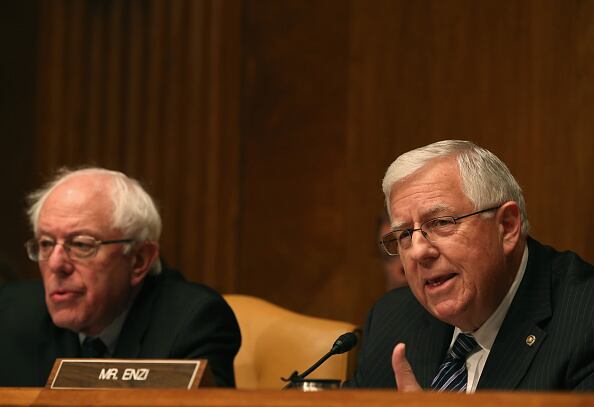
WASHINGTON — The Senate's GOP budget pointman says raising federal spending caps would "require" raising taxes, a notion that for many Republican members is politically toxic.
The 2011 Budget Control Act put in place spending caps that limit annual defense and domestic spending levels. With Republican defense hawks warning the military is underfunded and Democrats saying the domestic cuts are a drag on the economy, there are talks on Capitol Hill about a second deal that would again temporarily bust the caps.
But the construct of such a deal, which would be patterned after the late-2012 deal brokered by Rep. Paul Ryan, R-Wisc., and Sen. Patty Murray, D-Wash., has yet to take shape. Some insiders doubt the political climate later this year will be one in which a bipartisan deal that can pass both chambers could take root.
One leading fiscal hawk signaled Wednesday that tax hikes remain a non-starter for conservative GOP members.
"Removing the threat of sequester by raising these budget caps without increasing the debt in the short term would require raising taxes," Senate Budget Committee Chairman Mike Enzi, R-Wyo., said on the chamber floor.
"We know that both sides want the caps from the Budget Control Act removed, but at what price for our nation and its hardworking taxpayers?" Enzi asked. "Our military leaders have already told us that the debt is a threat to national security."
He called on Republicans and Democrats to work together on fiscal issues. But Enzi also reiterated what many Republicans see as Washington's main problem: government spending.
"It's time that both parties get serious about addressing our nation's chronic overspending," the Bbudget Ccommittee chairman said.
And he made clear he thinks the Pentagon should not be exempted from spending reductions.
"In the budget, defense was given $90 billion more than the budget caps — $38 billion more than the Ppresident requested," he said. "When it comes to defense, we are literally trying to outbid the Ppresident, who with a Democrat Congress raised taxes to get his budget to this level.
"Last year, Congress funded items the Department of Defense didn't approve or ask for and costs for major equipment exceeded approved amounts by billions," Enzi said.
Enzi also warned that the nation's debt level soon could put the Defense Department budget at risk.
"Interest on the debt could soon put America out of the business of funding defense, education and highways," he said.
But are the American people moving away from the fiscal hawks?
Citing a recent Gallup poll, federal budget analyst Stan Collender earlier Wednesday pointed out " the federal budget and deficit are missing from the list of the top issues that voters say will be important to them in the next presidential election."
"The deficit has so disappeared as an issue that a Republican-majority Congress is very likely to boost federal spending by close to $100 billion next year without any concern about political reprisals at the polls," Collender wrote in a blog post. "That's an approximately 20 percent increase in the deficit over the deficit that otherwise would occur."
Notably, Collender notes that "budget scold groups" in Washington have gone silent. More notably, he points out the financial sector has dropped the deficit as an issue of its congressional lobby.
"The Street seems to want no federal budget-related drama and as of now seems intent on pushing congressional leaders to avoid a fight over the debt ceiling increase that will be needed by the end of the year," he writes. "I can safely report that the federal deficit that before was fading now has definitely disappeared."
Twitter: @bennettjohnt