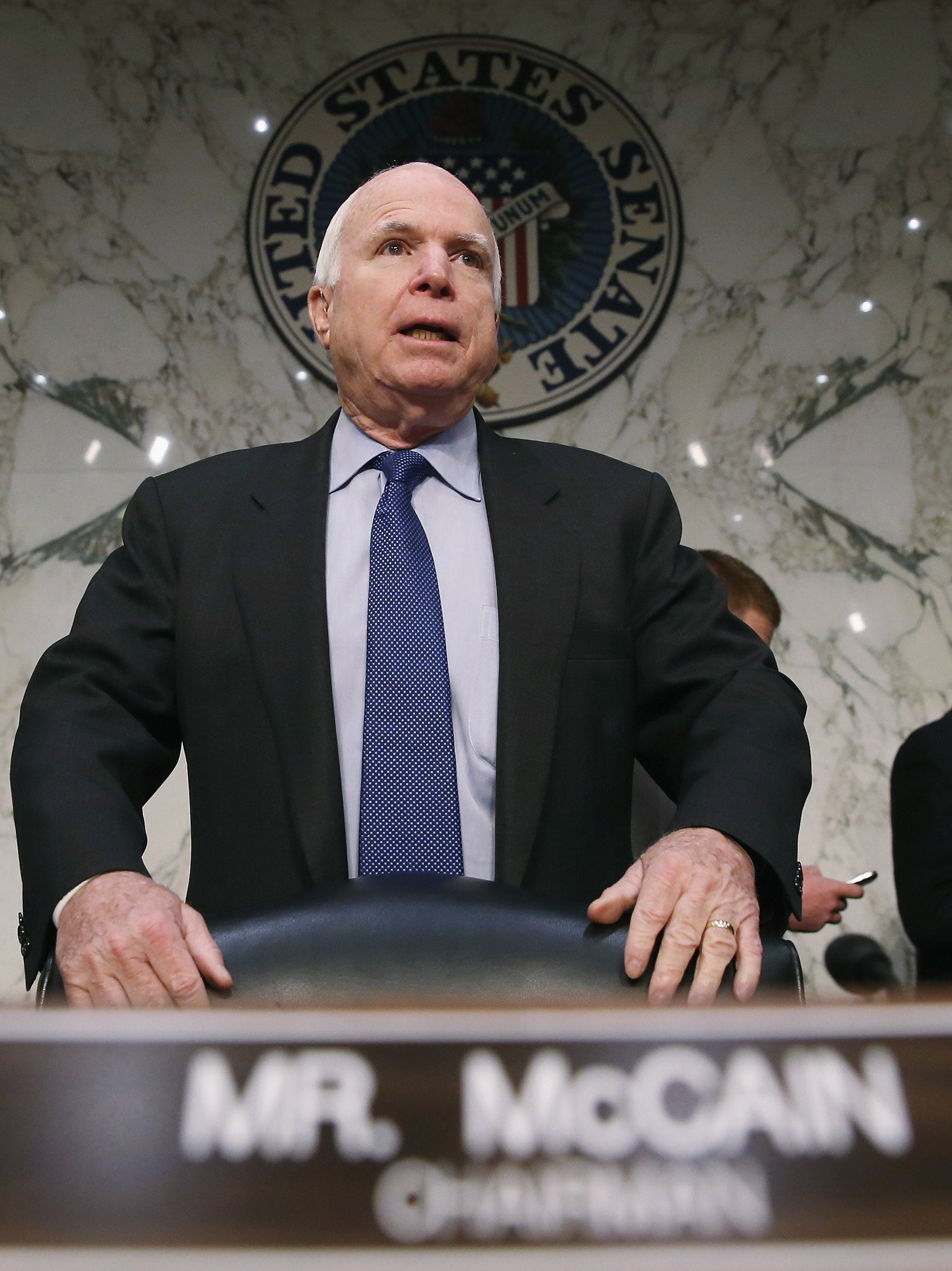
 WASHINGTON — For the US national security sector, November's midterms amounted to a status-quo election — with one glaring exception: Industry irritant John McCain became Senate Armed Services Committee (SASC) chairman.
The Nov. 4 Republican tidal wave delivered a bigger GOP majority in the House and control of the Senate. The defense and national security committees in the Senate have new chairmen — but all are familiar faces to the Pentagon and arms manufacturers.
Voters also sent most sitting members of national security committees back to the Capitol. And so far, this familiar-faces-in-new-places arrangement is yielding predictable results.
For defense, the biggest change — and one feared by many in the defense community — will be the new SASC chairman.
McCain is seen on the Hill as a top Pentagon and defense-sector ally. After all, he is perhaps the most vocal proponent of a US foreign policy that includes the widespread use of the American military. And he wants to get rid of the remaining defense sequestration cuts.
But within defense circles, he's viewed as the sector's biggest threat.
"Rolling back sequestration is necessary to provide our military the strategy-driven budget necessary to confront the threats we face," McCain said at the start of a Feb. 4 hearing. "But it will never be enough without reforming how the department procures major weapon systems.
"Many of our military's challenges today are the result of years of mistakes and wasted resources," he said. "Even more astounding than the amount of money squandered and wasted is the fact that, in each of the weapon system cases I have mentioned, no individual has been held responsible for these massive cost overruns and egregious acquisition failures."
In the House, Rep. Mac Thornberry, R-Texas, easily secured enough GOP caucus votes to become the House Armed Services Committee (HASC) chairman.
Thornberry is, unlike McCain, a big recipient of defense-sector campaign contributions. But since taking the gavel, he has shown a willingness to throw a sharp elbow or two.
"Some people expect lawmakers to just cut the check and not ask too many questions," Thornberry said during a Jan. 20 speech. "But Congress should not give any president a blank check, nor should Congress be a rubber stamp. It is the branch of government most responsible for the character and the contours of our military.
"In the Constitutional Convention, the founders gave certain powers to the Congress, which they viewed as the branch closest to the people," he said. "James Madison said that these powers ought to exist without limitation, because it is impossible to foresee or define the extent or variety of national exigencies."
One of the most eye-catching moves among the congressional defense and national security committees was McCain's appointment of House member-turned-Sen. Tom Cotton, R-Ark., as Airland subcommittee chairman.
The appointment puts Cotton — though McCain will have final say — over the largest swath of the committee's annual Pentagon policy bill. And in his early weeks as a senator, Cotton is wasting no time letting his new colleagues know he plans to be aggressive on national security and foreign policy matters.
Just three weeks after being sworn in, Cotton sent a message about how he views his role on issues like Iran's nuclear weapon ambitions during a Senate Banking Committee hearing where the panel easily approved a bill that would slap new sanctions on Iranian individuals and businesses.
"First, I would say that I think it was a mistake to ever go down this path," Cotton said at the hearing, referring to the Obama administration's decision to enter into talks with Iranian leaders. "Iran is a radical Islamist theocracy whose constitution calls for jihad."
Some Returned, Some Didn't
For the defense sector, voters returned a slew of incumbent House panel leaders to the Capitol — including House Appropriations Committee defense subcommittee (HAC-D) Chairman Rodney Frelinghuysen, R-N.J., a leading recipient of arms-maker campaign cash; House Foreign Affairs Committee (HFAC) Chairman Ed Royce, R-Calif.; former HFAC Chairwoman Ileana Ros-Lehtinen, R-Fla.; Air Force veteran and up-and-coming HFAC member Adam Kinzinger, R-Ill.; F-35 ally and HAC-D member Kay Granger, R-Texas; and HASC member and Iraq war veteran Tulsi Gabbard, D-Hawaii.
Former Senate incumbents of national security committees had a bumpier ride.
Gone are Senate Armed Services strategic forces subcommittee Chairman Mark Udall, D-Colo., as well as SASC member Kay Hagan, D-N.C., both swept out by the GOP wave. Also gone will be Senate Appropriations defense subcommittee member Mark Pryor, D-Ark.
Frelinghuysen again is the HAC-D boss. Hal Rogers, R-Ky., and Pete Visclosky, D-Ind., were re-elected and will remain as chairman and ranking member, respectively, of the full House Appropriations panel.
But in the Senate — due to retirements and a grumpy, anti-incumbent and anti-Democrat electorate — defense and national security professionals should get ready for some major changes.
SASC Chairman Carl Levin, D-Mich., retired. His preferred heir apparent, Vice Chairman Jack Reed, D-R.I., was re-elected and is the ranking SASC Democrat. Dianne Feinstein, D-Calif., shifted from the chairman's to the vice chairman's seat.
Sen. Richard Burr, R-N.C., became chairman of the Intelligence Committee due to the retirement of Vice Chairman Sen. Saxby Chambliss, R-Ga. Among other things, Burr has criticized efforts to make the intelligence apparatus more transparent.
With the GOP taking over, Foreign Relations Committee Ranking Member Bob Corker, R-Tenn., took the gavel from the former chairman, Sen. Robert Menendez, D-N.J. Corker has emerged as perhaps the most important lawmaker in the effort to push a new authorization for the use of military force through both chambers.
In another Senate change, the Appropriations Committee gavel moved from the former Democratic chairwoman, Barbara Mikulski of Maryland, to its former ranking GOP member, Thad Cochran of Mississippi, who survived a re-election fight. Cochran also will be the panel's Defense subcommittee chairman, with Dick Durbin, D-Ill., moving to the ranking member's post.
One consulting firm said all the leadership changes could affect individual companies.
"Lockheed Martin and Boeing would see some minor dings due to the demotions" of Mikulski and Durbin, according to Guggenheim Securities, which also said McCain "has a well-earned reputation as being a critic of a litany of Pentagon acquisition programs."
One defense lobbyist said, "I think McCain as [SASC] chairman will be good for a few [defense] companies, but for the vast majority, it's not going to be positive. Most chairmen these days are friends of the industries in their jurisdiction. John McCain is not a friend of the defense industry."
Email: jbennett@defensenews.com