WASHINGTON – Congressional Republicans are stepping up efforts to legally authorize America’s fight against the Islamic State, with the House GOP leader calling out President Barack Obama.
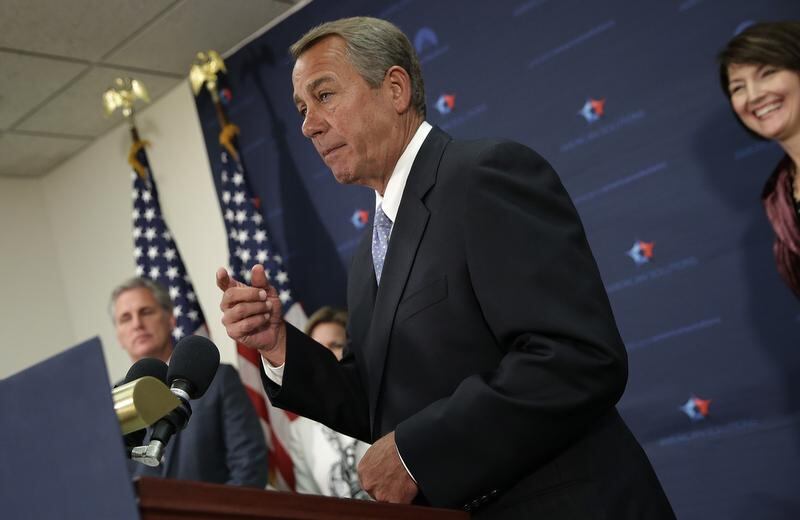
House Speaker Rep. John Boehner, R-Ohio, used part of his weekly press briefing Thursday to press the White House to draft and deliver to Capitol Hill a measure that would, if approved, put Congress' blessing on the US strikes in Iraq and Syria.
With both chambers slated to be in session only four or five more days this session, if looks like a virtual lock that if Congress does vote on a final force-approving measure, it will happen next year.
"In the new Congress, I would urge the president to submit a new authorization for the use of military force regarding our efforts to defeat and destroy [the Islamic State]," Boehner told reporters.
As other GOP members involved in the debate over a new authorization for the use of military force (AUMF), like incoming Senate Foreign Relations Committee Chairman Sen. Bob Corker, R-Tenn., Boehner had a history lesson for Obama.
"I reminded the president last month that, historically, the commander in chief has identified the need for the use of military force, written a new AUMF, sent it to Capitol Hill, and worked to build bipartisan support for that measure," the speaker said.
In a rare moment, Boehner alluded to the bipartisan consensus on the Hill that a new force measure is needed.
"I told him if he does that, House Republicans will be ready to work with him to get it approved," Boehner said.
Corker has said for several weeks that the White House, in his conversations with aides, "are not ready" to write and submit an AUMF.
While Corker has stopped short of criticizing the Obama administration for not sending up a new measure, Boehner sees "no urgency on the part of this White House."
"The White House needs to show some urgency because the strategy isn't reversing the terrorists' momentum on the ground," he said, also calling for a new strategy from the White House.
"I've got grave concerns that the president — the plan he's put in place — is not going to accomplish the goal of defeating and destroying [the group]," Boehner said. "We need a more robust, comprehensive strategy, and that should start with a new [AUMF]."
A major unresolved issue is on what will the House and Senate vote. Several AUMFs have been introduced, and, in a surprise move, the Senate Foreign Relations Committee decided Thursday to vote on a version next Wednesday.
"We will now have the opportunity to engage in a meaningful, transparent debate on the US military mission against [Islamic State], as I've been calling for since military action began nearly four months ago," Sen. Tim Kaine, D-Va., a leading AUMF proponent, said Thursday. "We owe it to our service members and the American people to have this debate and take this vote before adjourning for the year, and I'm pleased we're on track to do so in the right way. "
The decision came after Kaine and Sen. Rand Paul, R-Ky., squared off over the latter's attempt at a committee hearing to bring to a vote a measure declaring war on the Islamic State as an amendment to an unrelated bill.
Lawmakers from both parties have been calling for a force-authorization measure for several months. President Obama acquiesced to those demands, at least rhetorically, on Nov. 5, saying he wanted lawmakers to debate and vote on a new measure.
Republican lawmakers countered by saying Obama should craft and submit a draft to Congress. From there, negotiations among lawmakers and with the White House would begin.
So far, the administration has yet to send up any measure.
"Although the president has the authority to address the threat from [the Islamic State], he has said that we are strongest as a nation when the executive branch and Congress work together on matters involving the use of US military force," spokeswoman for the White House Naional Security Council. Bernadette Meehan told CongressWatch Nov. 21. "The administration is therefore engaging with the Congress on a new AUMF.
"The goal of this engagement is to produce an AUMF that specifically addresses the current fight and, as the president has said, 'reflects what we perceive to be not just our strategy over the next two or three months, but our strategy going forward'," she said. "We will continue to engage with the Congress on the elements of an AUMF to ensure that they are appropriately tailored, while still preserving the authorities the president needs to execute his counter-[Islamic State] strategy and to respond as might be necessary to defend the United States." ■
Email: jbennett@defensenews.com.