Growing from Reagan-era Star Wars concepts of the Strategic Defense Initiative (SDI), ballistic missile defense (BMD) has evolved into a major war fighting element of its own. It encompasses layered defensive strategies, fielded primarily by the Army and Navy but overseen and funded by the Pentagon's Missile Defense Agency (MDA).
The technological sophistication is difficult to match. A wide variety of sensors and weapon systems are employed to cover the four basic phases of an enemy ballistic missile – boost, ascent, mid-course and terminal – with forces fielded in the United States, on warships, and most recently in Romania, with another installation planned in Poland.
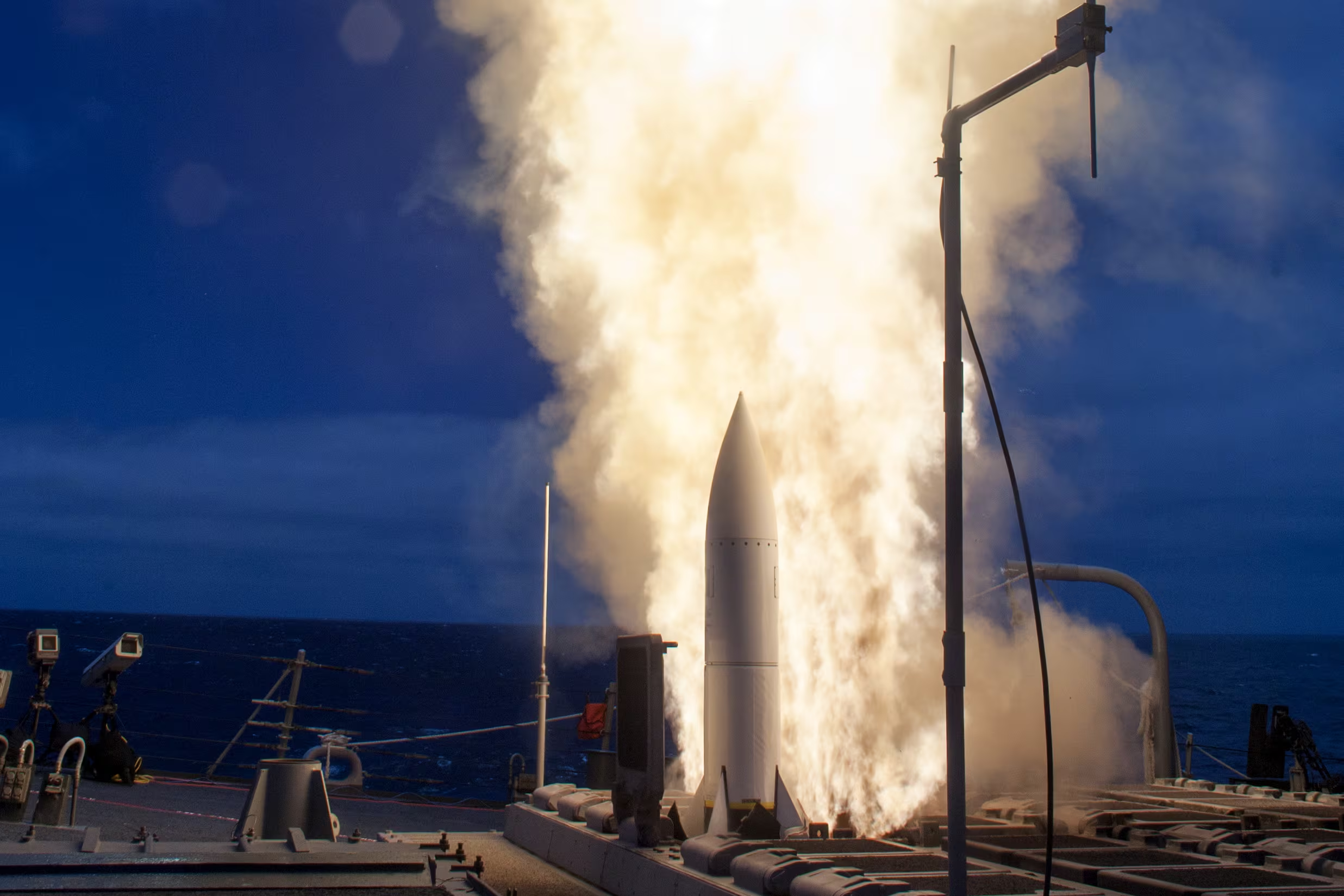
And then there are the variety of systems. Naval forces and the Romanian and Polish installations rely on the Aegis combat system, which was adapted – initially as something of an interim measure – to become an effective BMD weapon. While the original SDI was aimed at countering Soviet missiles, the current system is considered to face more imminent potential threats from North Korea or Iran.
"Though the capability remains under a veil of doubt, new advances in sensing and interceptor characteristics appear promising, even in moving beyond its original air defense focus to field credible ballistic missile defense, anti-satellite capabilities, and even an anti-surface SM-6 variant," said Mackenzie Eaglen, a resident fellow in the Marilyn Ware Center for Security Studies at the American Enterprise Institute and a member of the Defense News advisory board. "AEGIS turned the DDG-51 into the most versatile warship ever; it served as the core of the Navy’s move toward networked warfare and will continue to play a pivotal role in the new push toward distributed lethality."
But there are many other systems noteworthy in their own right, both in terms of capabilities and their ability to combat distinctive threats. Internationally there's the Iron Dome in Israel, which touts the destruction of 90 percent of missiles it has targeted. Mark Thompson, currently CEO of The New York Times Company
,
wrote that the "lack of Israeli casualties suggests Iron Dome is the most-effective, most-tested missile shield the world has ever seen."
And then protecting the US homeland is the Ground-Based Midcourse Defense program – the anti-intercontinental ballistic missile system for intercepting incoming warheads in space. The technological advancements that led to the ability for a bullet to hit a bullet at supersonic speed have provided a homeland capability against such threats as North Korea and Iran, but also acted as a powerful means of deterrence, said Bill Phillips, former chief of acquisitions for the Army and now a vice president with Boeing, the main program contractor.
"If our nation had not pursued GMD, North Korea and Iran would have certainly continued their pursuit of ICBMs and nuclear weapons," said Phillips, who is also a member of the Defense News advisory board. "And today, we would have no counter to that threat except for offensive retaliatory action; our influence and interests across the world would be held at risk, and the nation’s economic ambitions across the globe would be held in check."
Jill Aitoro in Washington and Barbara Opall-Rome in Tel Aviv
contributed to this report.
This article is part of a larger Defense News 30-year anniversary project, showcasing the people, programs and innovations from the last three decades that most shaped the global security arena. Go to defensenews.com/30th to see all of our coverage.
More In