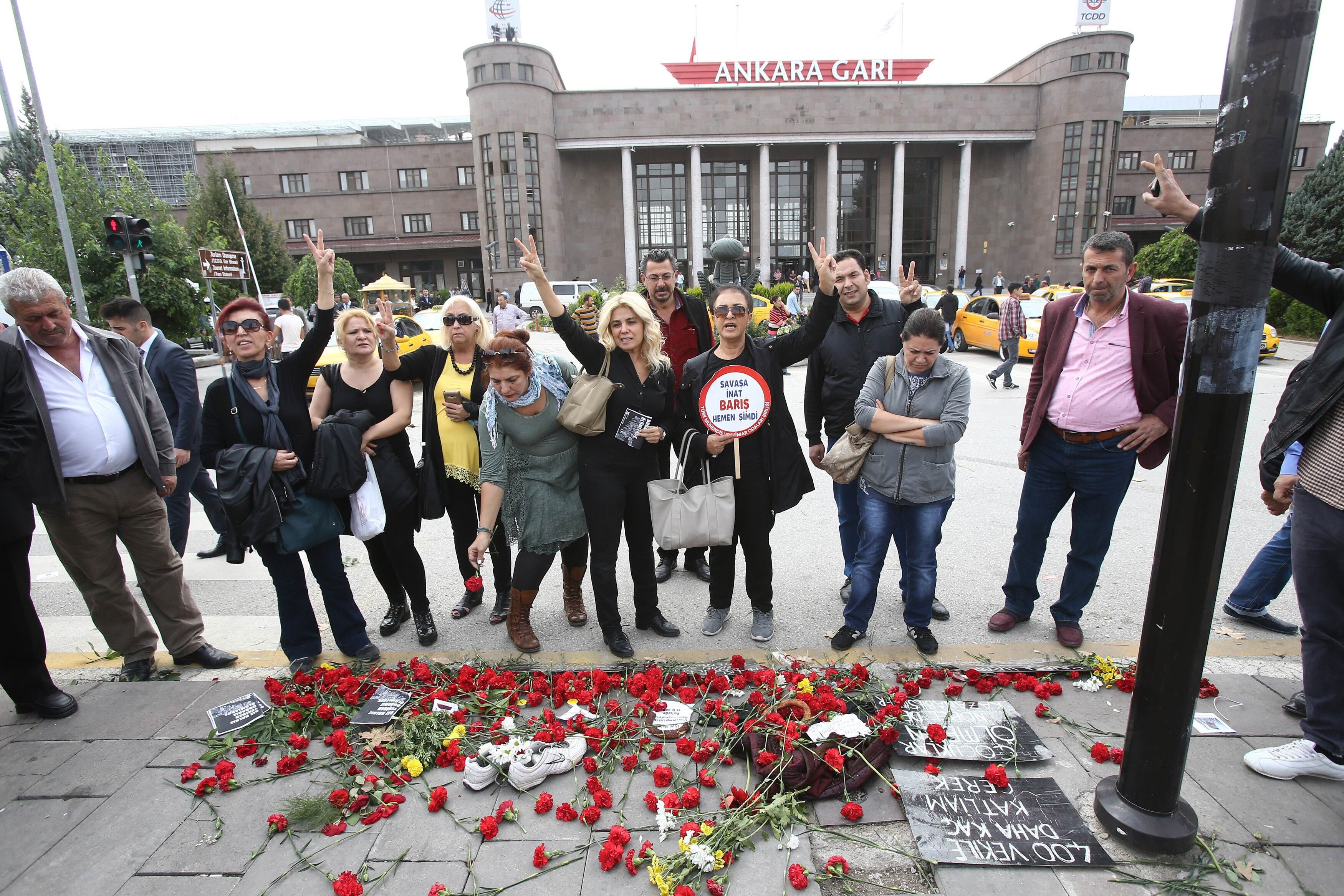
ANKARA — Turkey witnessed the worst terror attack in its history Oct. 10 when two suicide bombers' explosions erupted during a peace rally outside the capital's main train station, killing more than 100 people and injured hundreds more.
Two important messages are emerging after the attack: Turkey's assertive Middle East policy since the Arab Spring's aftermath has created major threats to homeland security; and the country is not sufficiently prepared for terror threats in urban areas.
"Sadly, it's payback time for Turkey who once got too close with jihadists operating in Syria and Iraq," said one western ambassador. "Obviously, Turkey's capabilities to deal with the evil men of the Middle East are well below [where] it thought they were. Turkey should rethink its Middle Eastern ambitions."
Turkey has been ambitiously supporting Sunni Islamist regimes in Tunisia, Libya and Egypt and Syria//Syria's leaders is Alawite, and Turkey has been trying to get Assad since violence broke out in these countries after the Arab Spring.
Most obsessively, Ankara has sought to oust Syria's pro-Shia president, Bashar al-Assad and install his replacement through "mildly Islamist" Sunni groups. That goal was until this year was widely believed to have included logistical support and arms shipments to radical Islamist groups operating in Syria.
Under pressure from its western allies, Turkey earlier this year decided to open its air bases to the allied military campaign against the biggest jihadist group, the Islamic State group, that has captured large swaths of land in neighboring Syria and Iraq since summer 2014, and later it joined itself in air raids against the group know as ISIL or ISIS. In return, ISIL vowed to fight Turkey.
Prime Minister Ahmet Davutoglu said Oct. 14 that the suspects in the Ankara bombings had links with ISIL and possibly with Kurdish militants.
Since July, Turkey's security forces have been fighting militants from the Kurdistan Workers' Party (PKK) after the group ended a unilateral ceasefire it had declared in 2013. The PKK ended its ceasefire after another ISIL-linked suicide bombing July 20 killed 33 activists at a pro-Kurdish meeting in a small Turkish town on the border with Syria.
More than 150 Turkish security forces and hundreds of PKK militants have been killed since then in clashes mostly in Turkey's predominantly Kurdish southeast and in Turkish air raids against PKK strongholds in northern Syria.
"Turkish intelligence and preemptive strike capabilities against the PKK are fairly reliable," said one security expert here. "But ISIS and similar groups running clandestine cells in big cities are a more difficult fight and relatively unchartered territory for the security system."
One western security analyst in London said: "The attack highlights Turkey's failures in urban anti-terror warfare, including its cyber and intelligence capabilities."
One industry official said that the attack would make Ankara an eager buyer of "any system" that could bolster Turkey's anti-terror fight.
"In addition to reviewing its operational and administrative capabilities the Turks will hope to reinforce their (urban) anti-terror gear. Any system designed to boost intel capabilities would be welcomed, especially but not necessarily locally developed systems, " he said.
But one procurement official refused to comment. "The nation mourns its dead. It is too premature to talk about new systems. In theory, Turkey has always been threatened by various types of terror and in need of anti-terror capabilities."
Burak Ege Bekdil was the Turkey correspondent for Defense News.