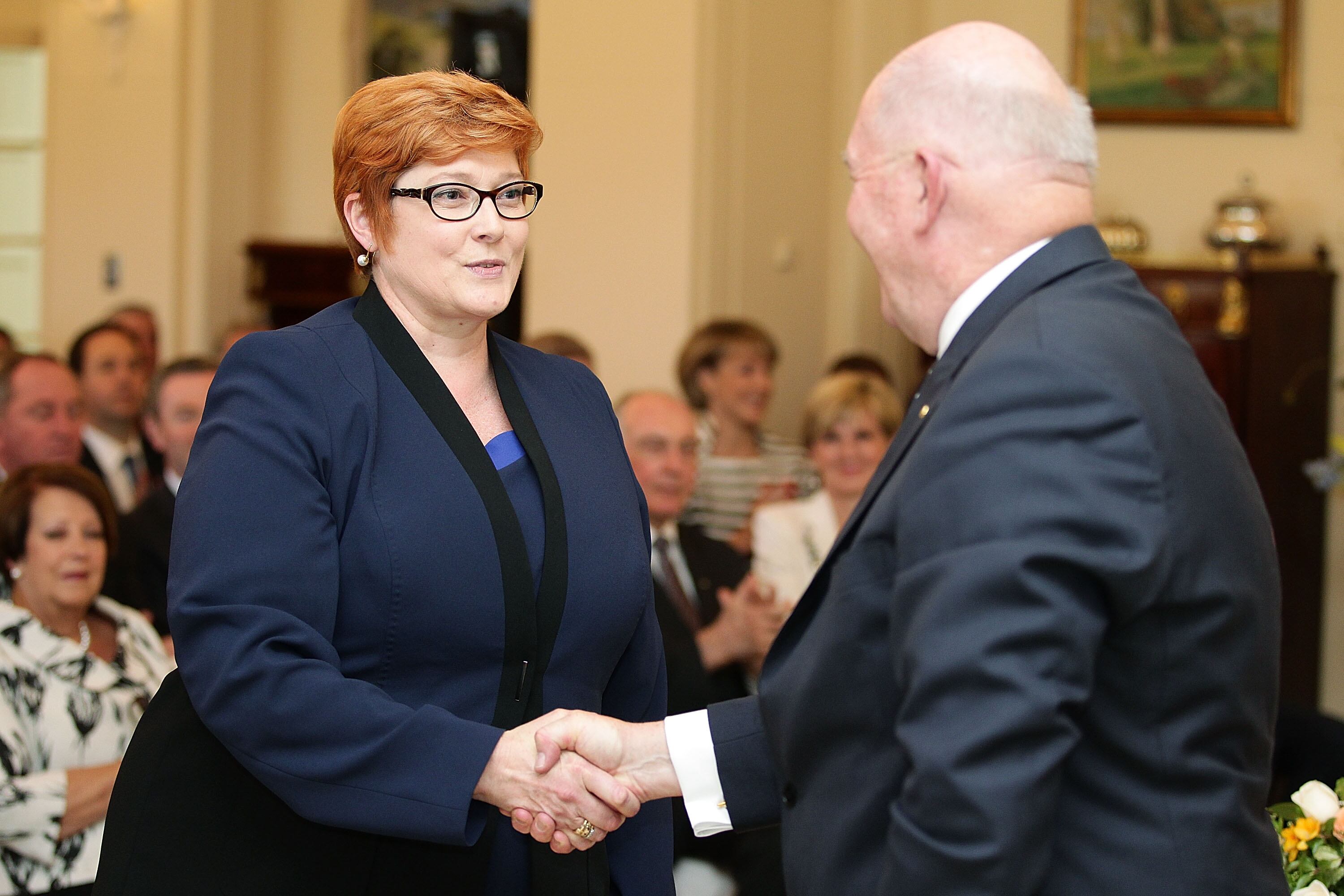
MELBOURNE, Australia — Marise Payne was sworn in Sept. 21 as Australia's new defense minister for Defence on September 22, becoming the third person in less than a year to hold the portfolio.
Payne replaceds the former Defence Minister Kevin Andrews, who lost his job as part of a Cabinet reshuffle in the wake of a Sept. 14 last week’s Liberal government leadership change, which saw that ousted Malcolm Turnbull replace Tony Abbott as Australia’s prime minister in favor of Malcolm Turnbull. Andrews had only held the Defence portfolio post only since December last year when he replaced the fired Sen.ator David Johnston.
The ‘leadership churn’ is causing concern in the Australian Defence Organisation and among industry as several major acquisition projects are in need of timely awaiting decisions. Prime among these are the Future Submarine (Sea 1000) project, which is now in the midst of a competitive evaluation process (CEP) to select a replacement for the Royal Australian Navy’s Collins-class boats, and the Future Frigate (Sea 5000), for which a CEP is set to begin in October.
Together with the Ooffshore Ppatrol Vvessel (OPV) to be acquired under Project Sea 1180, the frigate and submarine programs will determine the future of Australia’s naval shipbuilding industry, which is facing a ‘valley of death’ dire straits after completion of the three aAir wWarfare dDestroyers now under construction in South Australia.
In August, Abbott and Andrews had announced plans to bring the frigate program forward by three years and the OPV by two. Steel for the first of eight frigates is due to be cut in 2020, just five years from now.
Kevin Andrews had offered to remain in the role of as defense minister, telling reporters before the Cabinet reshuffle that it was important to retain continuity.
"Well we’re at a very significant time so far as defencse is concerned. We’re about to bring out a wWhite pPaper. We’re in the midst of the submarine evaluation. We’re in the midst of replacing the Navy almost completely over the next decade or so," he said. "It takes a long time to get on top of the complexity of defencse and ... I would be happy to continue in this role, because I don’t think it’s good for the security and the safety of this country and for the well-being of our defencse forces to keep changing defencse ministers."
LaterFollowing his dumping, Andrews said he was disappointed that the prime minister chose not to accept his offer.
"Frankly, my remaining in this job was not about me, it was about stability for our defense force and its leadership," he said. "Mr. Turnbull’s decision means that there have been more defencse ministers than prime ministers in the last three years."
When elected in 2013, the Abbott government commissioned a review into Defence, to ensure that the Australian Defence Oorganisation was "fit for purpose and able to deliver against its strategy with the minimum resources necessary." The First Principles Review found that "leadership churn" was a major issue, noting that noted there had been nine minsters, six secretaries and five cChiefs of the Australian Defence Force since 1998, with an average tenure of four years. Marise Payne is now the tenth 10th defense minister since 1998.
"Leadership churn and budget uncertainty are the critical root causes of the organisation’s complacency," the report states. "The frequent turnover in mMinisters and sSecretaries, in particular, does not enable effective leadership of change. The state of the organisation is symptomatic of one that has not been materially reshaped for over a decade and has been allowed to drift."
Dr Andrew Davies from the Australian Strategic Policy said that tThe average tenure of the last five defense ministers is just was 571 days, said Andrew Davies of the Australian Strategic Policy Institute.
"In a specialiszed portfolio that has deployments and multi-billion-dollar projects that last years or decades, having a 'bungee boss' can’t be good," Davies said. "Let’s hope we’re now about to see greater stability."
In her first press conference on Sept.ember 22, Marise Payne, who is Australia’s first female defense minister, said that it was too early to announce new or changed priorities.
"I can absolutely commit to being here for the long haul and the long time, and to say that this is about an opportunity for someone to come into the role and to pursue it over an extended period of time," she said in response to a question on her thoughts about the "revolving door" for recent defense ministers in recent times. "I have no intention of walking away from politics any time soon. I am a new member of Cabinet and I think that should be a very important message to Defence, that this is the commitment this government gives. I have every intention of backing that up."
Payne reaffirmed that the government’s Defence defense white paper — (now overseen by two prime ministers and three defense ministers since its inception) in late 2013 — would be released in accord with the previous timetable. The White Paper is expected to be released in October or November as planned., and if If the bleak times facing Australian shipbuilding ‘valley of death’ is are to be minimized and a viable industry retained, some important decisions will need to be made very shortly thereafter, she said.
Email: npittaway@defensenews.com
Nigel Pittaway is the Australia correspondent for Defense News.